The Ark: Ambrose and Augustine

I’d like to return to our ongoing discussion of how the Church sees the Ark of the Covenant. In our previous post in this series, we looked at the poetry of Saint Ephrem the Syrian. Now we’ll turn our eyes westward to examine what some of the most well-known western saints, Ambrose and Augustine, said about the typology expressed by the Ark.

Saint Ambrose of Milan

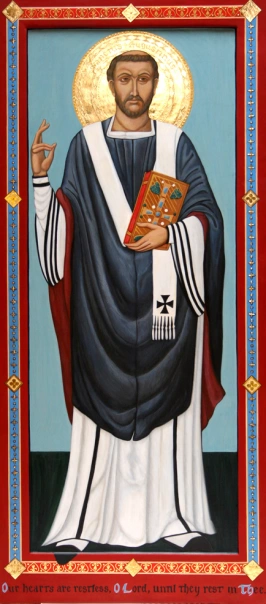
ambroseofmilanSaint Ambrose, living from 340-397, provides perhaps the clearest “rationale” for seeing the Ark as a type of Mary. He draws a number of parallels between the Ark and the Virgin in which those applied to the Virgin exceed those of the Ark. He contrasts the Law with the Gospel, the voice of God with the Word of God, and the glitter of gold with the splendour of virginity.

The prophet David danced before the Ark. Now what else should we say the Ark was but holy Mary? The Ark bore within it the tables of the Testament, but Mary bore the Heir of the same Testament itself. The former contained in it the Law, the latter the Gospel. The one had the voice of God, the other His Word. The Ark, indeed, was radiant within and without with the glitter of gold, but holy Mary shone within and without with the splendour of virginity. The one was adorned with earthly gold, the other with heavenly.1

Saint Augustine of Hippo

saugustin02Saint Augustine, living from A.D. 354-430, seems to be one of the few among his contemporaries who holds the Ark to be a type of the Church as the body of Christ rather than a type of the Virgin Mary. The very passage that Saint Gregory Thaumaturgus earlier interpreted as speaking of the Holy Virgin, Augustine interprets as referring to the Church.

Arise, O Lord, into Your resting place [cf. Psalm 131]. He says unto the Lord sleeping, Arise. You know already who slept, and who rose again… You, and the ark of Your sanctification: that is, Arise, that the ark of Your sanctification, which You have sanctified, may arise also. He is our Head; His ark is His Church: He arose first, the Church will arise also. The body would not dare to promise itself resurrection, save the Head arose first. The Body of Christ, that was born of Mary, has been understood by some to be the ark of sanctification; so that the words mean, Arise with Your Body, that they who believe not may handle.2

In the next post in this series, we will examine the more practical approach to this topic as presented by Saint Jerome.


1 Qtd. in Thomas Livius, The Blessed Virgin in the Fathers of the First Six Centuries, (London: Burns and Oates, Limited 1893), p. 77.

2 Saint Augustine of Hippo, Exposition on Psalm 132, trans. J.E. Tweed, from Nicene and Post-Nicene Fathers, First Series, Vol. 8, ed. Philip Schaff, (Buffalo, NY: Christian Literature Publishing Co., 1888), revised and edited for New Advent by Kevin Knight, <http://www.newadvent.org/fathers/1801132.htm>, .

The Ark: Saint Ephrem

ephrem_miniature_16cNow we come to one of my favorite parts of our ongoing discussion about how the Church perceives the Ark of the Covenant. In the works of Saint Ephrem, a contemporary of Saint Athanasius, we find the most poignant expression of this typology to date. Saint Ephrem’s poetic genius strikingly and undeniably expresses the beauty of the typology. Saint Ephrem references this typology multiple times. Below are two of the most interesting references.

With the weapon of the deceiver the First-born clad Himself, that with the weapon that killed, He might restore to life again! With the tree wherewith he slew us, He delivered us. With the wine which maddened us, with it we were made chaste! With the rib that was drawn out of Adam, the wicked one drew out the heart of Adam. There rose from the Rib a hidden power, which cut off Satan as Dagon: for in that Ark a book was hidden that cried and proclaimed concerning the Conqueror! There was then a mystery revealed, in that Dagon was brought low in his own place of refuge! The accomplishment came after the type, in that the wicked one was brought low in the place in which he trusted! Blessed be He Who came and in Him were accomplished the mysteries of the left hand, and the right hand. Fulfilled was the mystery that was in the Lamb, and fulfilled was the type that was in Dagon.1

In this cryptic passage, St. Ephrem begins by enumerating weapons by which the devil attacked humanity: flesh, wood, wine, and woman. For each item in his enumeration he alludes to how the devil used it as a weapon and God used it for salvation. The climax of his enumeration is the woman. Out of the female half of the race, God brought forth a hidden power, the Holy Virgin Mary. Mary is the antitype of the Ark that destroyed the idol of Dagon when the Philistines captured the Ark and housed it in the temple of Dagon (1 Samuel 5:1–7). In the Ark, as in the Virgin, was a book. The book, or tablets of stone, is a type of the only begotten Son and Word of God. The human race fell through the woman, but through the woman the human race was raised up and the wicked one was brought low. Each of the tools used as weapons by the devil contributed to his undoing and thus the typology behind the story of Dagon is revealed: the devil was brought low in the place in which he trusted.

In another passage, St. Ephrem uses juxtaposition to call out the typology. The woman ministers before the man by nature of his headship. Likewise, Joseph ministered before Mary because in her was the Son of God. The last sentence juxtaposes this with the priestly ministry before the Ark. Just as the priest ministered before the Ark because God was present in it, Joseph ministered before Mary. Thus the Ark typifies Mary.

The woman ministers before the man, because he is her head. Joseph rose to minister before his Lord, Who was in Mary. The priest ministered before Your ark by reason of Your holiness.2

In our next post in this series, we will examine what both Saints Ambrose and Augustine contributed to this discussion.


1 Saint Ephrem, Hymns on the Nativity, Trans. J.B. Morris (Hymn nos. 1-13) and A. Edward Johnston (Hymn nos. 14-19), in Nicene and Post-Nicene Fathers, Second Series, Vol. 13, ed. Philip Schaff and Henry Wace, (Buffalo, NY: Christian Literature Publishing Co.,1898), revised and edited for New Advent by Kevin Knight, hymn 3.

2Ibid., hymn 11.

The Ark: Gregory and Athanasius

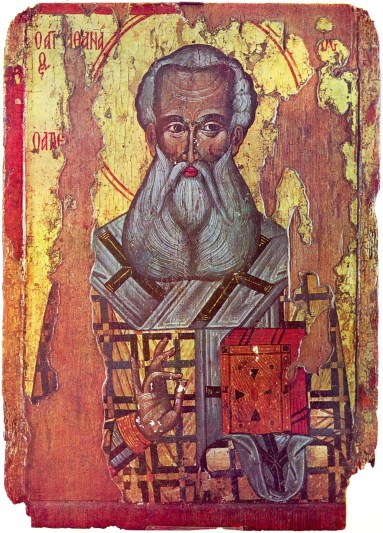
saint-athanasius-of-alexandria-icon-sozopol-bulgaria-17century

Saint Athanasius the Great (and also my patron saint)

In our previous post, we looked at what Saint Dionysius of Alexandria about the Ark of the Covenant. Saint Gregory the Wonderworker and Saint Athanasius the Great didn’t have a lot to say, but what they said (or might have said) is worth looking into, so I’ve combined them into a single post.

Saint Gregory Thaumaturgus

Saint Gregory the Wonder Worker, in his first homily on the Annunciation, draws a parallel between the Archangel Gabriel’s annunciation to the Theotokos and the Prophet David’s famous psalm, perhaps revealing its prophetic nature. In doing so, he elucidates the typological relationship between the Ark and the Mother of God:

Come, then, you too, dearly beloved, and let us chant the melody which has been taught us by the inspired harp of David, and say, Arise, O Lord, into Your rest; You, and the ark of Your sanctuary [cf. Psalm 131:8 OSB]. For the holy Virgin is in truth an ark, wrought with gold both within and without, that has received the whole treasury of the sanctuary.1

Saints Dionysius and Gregory, contemporaries and both students of Origen, seem to have arrived at slightly different views on the the ark’s typology. Saint Gregory seems to be the first of the Fathers to have undeniably identified the ark as a type of the Theotokos.

Saint Athanasius the Great

Saint Athanasius rose to prominence in the middle of the fourth century. While nothing is certain, several references are made to the Ark as type of the Theotokos in works attributed to Saint Athanasius. In a homily on the Annunciation, classified by Migne as a spurious work, the Theotokos is called the “Ark of Sanctification.”2 O’Carroll mentions two additional homilies attributed to St. Athanasius, also casting some doubt on the authenticity of the attribution. In one the Virgin is called “Ark of the New Covenant,” and in a homily on the Presentation of our Lord, “Ark of Sanctification.”3

In our next post, we’ll take a look at some of the poetry of Saint Ephrem the Syrian. Saint Ephrem’s thoughts are perhaps the most intriguing of the Fathers we will examine.


Saint Gregory Thaumaturgus, The First Homily On the Annunciation to the Holy Virgin Mary, trans. S.D.F. Salmond, from Ante-Nicene Fathers, Vol. 6, Ed. Alexander Roberts, James Donaldson, and A. Cleveland Coxe, (Buffalo, NY: Christian Literature Publishing Co., 1886), revised and edited for New Advent by Kevin Knight.

Thomas Livius, The Blessed Virgin in the Fathers of the First Six Centuries, (London: Burns and Oates, Limited 1893), p. 80.

Michael O’Carroll, Theotokos: A Theological Encyclopedia of the Blessed Virgin Mary, <Eugene, OR: Wipf and Stock Publishers 2000>, p. 50.

The Ark: Saint Dionysius of Alexandria

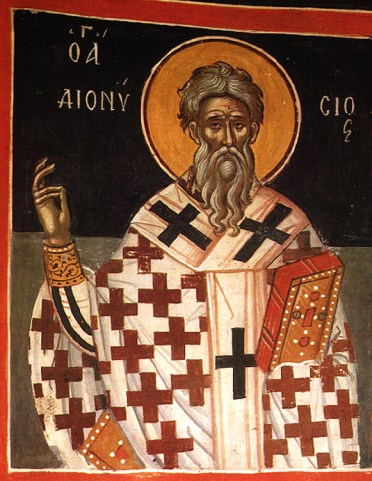
1005dionysiusIn our previous post, we discussed the earliest patristic linkage between the Ark of the Covenant and the Holy Mother of God. We continue here with the thoughts of Saint Dionysius of Alexandria.

Saint Dionysius was bishop of Alexandria in the middle of the third century. A letter bearing his name and written against Paul of Samosata is thought by many to be spurious. However, Bishop Bull makes a compelling case for the authenticity of this letter, making it worthy of a quick inspection.1 While not a direct reference to the Ark of the Covenant, we start to see the Theotokos likened to the tabernacle in which the Ark itself rested, in the middle of the third century.

As Christ our priest was not chosen by hand of man, so neither was His tabernacle framed by men, but was established by the Holy Ghost; and by the power of God is that tabernacle protected, to be had in everlasting remembrance, Mary, God’s Virgin Mother.2

This is not inconsistent with earlier views. If the Ark is a type of Christ and the tabernacle a type of His mother, the analogy remains consistent, for the tabernacle contained the ark. Thus we call Mary the Theotokos, or God Bearer.

In our next post in this series, we will examine what Saint Gregory the Wonderworker contributed to this discussion.


1 Bishop George Bull, Defensio Fidei Niceænæ, (Oxford: John Henry Parker, 1851), v. 1, p. 320.

2 Qtd. in Thomas Livius, The Blessed Virgin in the Fathers of the First Six Centuries, (London: Burns and Oates, Limited 1893), p. 81.

The Ark: Saint Hippolytus

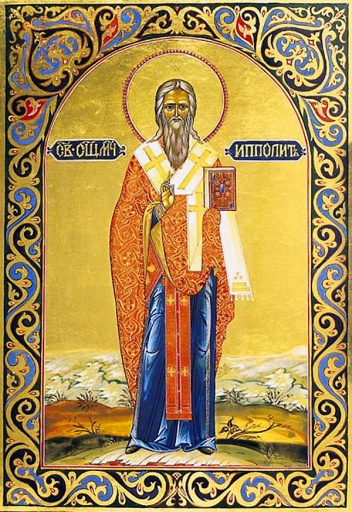
0130hippolytusIn our previous post, we began a survey of patristic thinking on the Ark of the Covenant, starting with Saint Irenaeus of Lyons. We will continue by moving into the third century.

While much of his work is lost, the Holy Hieromartyr Hippolytus, presbyter of the Church of Rome in the early third century and likely a student of Saint Irenaeus,1 provides two relevant mentions of the typology of the the Ark. In the only extant fragment from his commentary on Psalm 23, quoted by Theodoret, he strongly links the complete type with Christ, but connects the wood of the Ark with the human nature of the Holy Virgin. O’Carroll asserts that this passage is the first to expose a relationship between the Ark and the Theotokos.

And, moreover, the ark made of imperishable wood was the Saviour Himself. For by this was signified the imperishable and incorruptible tabernacle of (the Lord) Himself, which gendered no corruption of sin. For the sinner, indeed, makes this confession: “My wounds stank, and were corrupt, because of my foolishness.” But the Lord was without sin, made of imperishable wood, as regards His humanity; that is, of the virgin and the Holy Ghost inwardly, and outwardly of the word of God, like an ark overlaid with purest gold.2

Hippolytus’ interpretations of the visions of Daniel and Nebuchadnezzar include an attempt to link the physical dimensions of the Ark with historical time spans, which is irrelevant to the current discussion, but in the course of this diatribe he makes another comment revealing his understanding of the typology of the Ark:

the things that took place of old in the wilderness, under Moses, in the case of the tabernacle, were constituted types and emblems of spiritual mysteries, in order that, when the truth came in Christ in these last days, you might be able to perceive that these things were fulfilled … At that time, then, the Saviour appeared and showed His own body to the world, (born) of the Virgin, who was the “ark overlaid with pure gold,” with the Word within and the Holy Spirit without; so that the truth is demonstrated, and the “ark” made manifest.3

Comments by some scholars seems to indicate a variance in the translation of this passage that makes its meaning unclear to the author. McGuckin, for instance, claims that Hippolytus links the type with the Theotokos.4 It is unclear from the above translation whether the phrase, ‘who was the “ark overlaid with pure gold”’ modifies the noun “virgin” or “saviour,” though in the last phrase, the truth being demonstrated juxtaposed with the ark made manifest seems pretty clearly a reference to the Savior Himself. Migne’s latin rendering clearly makes the phrase parenthetical to the Virgin,5 but an alternative translation by Tom Schmidt seems to be more consistent with the commentary on Psalm 23 quoted above:

… the Savior comes from the Virgin, and then he offered the Ark, his own body, into the world, gilded in pure gold, inside with the Word, outside with the Holy Spirit, so that the truth may be shown and the Ark may be manifested.6

While Hippolytus does make a connection between the Ark and the Theotokos, it seems just as plausible that he saw the Ark in its completeness as a type of Christ. The likelihood that he was a pupil of Saint Irenaeus, who viewed the Ark as a type of Christ, along with the striking similarity between the two saints’ statements, reinforces this position.

In our next post, we will examine what Saint Dionysius of Alexandria had to say about the Ark. If you’re joining us late, you may wish to start at the beginning of our exploration of the Ark of the Covenant.


1 Johann Peter Kirsch. St. Hippolytus of Rome, The Catholic Encyclopedia, Vol. 7, <New York: Robert Appleton Company, 1910>.

2 Translated by S.D.F. Salmond, Fragments from the Scriptural Commentaries of Hippolytus, from Ante-Nicene Fathers, Vol. 5, ed. Alexander Roberts, James Donaldson, and A. Cleveland Coxe, (Buffalo, NY: Christian Literature Publishing Co. 1886) revised and edited for New Advent by Kevin Knight.

3 ibid.

4 John Anthony McGuckin, The Orthodox Church: An Introduction to its History, Doctrine, and Spiritual Culture, (Chichester: Wiley-Blackwell 2010), p. 220.

5 Collected by Joanne Alberto Fabricio and Andrea Gallandio, Operum S. Hippolyti Quæ Supersunt, in Patrologiæ Græcæ, J. P. Migne (1857), vol. 10, column 647.

6 T.C. Schmidt, Hippolytus of Rome: Commentary on Daniel, (Schmidt 2010), p. 141.

The Ark: The Patristic Witness

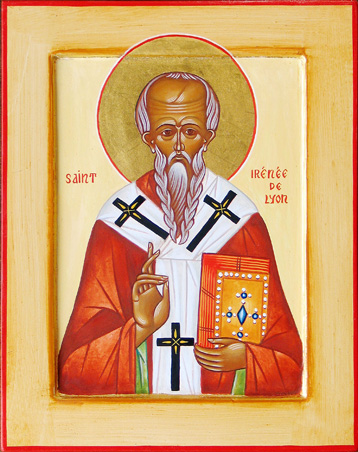
st-irenaeus-of-lyonIn our previous post, we wrapped up our discussion of apocryphal witnesses to the typology behind the Ark of the Covenant. In this post we’ll begin a lengthy chronological survey of how the ancient Fathers of the Church viewed the Ark. Please recall that, as I have noted several times, the Church tends to see the Ark as a type of the Holy Virgin. We will find that this view is not unanimous among the Fathers and tends to develop over the centuries.

Nowhere in the writings of the early fathers of the Church do we find a treatise on the role of the Mother of God in the economy of salvation. Rather, in order to ascertain the consensus of the Fathers, we must resort to collecting brief extracts scattered throughout works focused instead on the great doctrinal crises of the day, or perhaps in sermons, letters, or other pastoral works.1 In the following series of posts are collected relevant excerpts that demonstrate the development of the great patristic conversation over the centuries. We will begin as early as possible with Saint Irenaeus of Lyons.

The earliest patristic reference to the typology of the Ark, as far as this author is able to ascertain, is found in a couple of fragments from the lost writings of Saint Irenaeus of Lyons. The two fragments seem to largely overlap, and so I share from the most complete fragment below. Saint Irenaeus quite explicitly links the Ark with the body of Christ.

ark declared a type of the body of Christ, which is both pure and immaculate. For as that ark was gilded with pure gold both within and without, so also is the body of Christ pure and resplendent, being adorned within by the Word, and shielded on the outside by the Spirit, in order that from both [materials] the splendour of the natures might be exhibited together.2

In our next post, we will examine what Saint Hippolytus says about the Ark.


1 Thomas Livius, The Blessed Virgin in the Fathers of the First Six Centuries, (London: Burns and Oates, Limited 1893), p. 15.

2 Translated by Alexander Roberts, Fragments from the Lost Writings of Irenæus, From Ante-Nicene Fathers, Vol. 1. Edited by Alexander Roberts, James Donaldson, and A. Cleveland Coxe. (Buffalo, NY: Christian Literature Publishing Co., 1885.), Revised and edited for New Advent by Kevin Knight.

The Ark: The Dormition of the Mother of God

In the previous post in our ongoing discussion of the Ark of the Covenant, we discussed the Infancy Gospel of James. In this post we will take a look at another work that the Church values and which is represented in the life of the Church through the Feast of the Dormition, which we will discuss in a later post. As we have discussed, the Church most frequently sees the Ark as a type of the Holy Virgin.Screen Shot 2016-08-24 at 2.02.57 PM

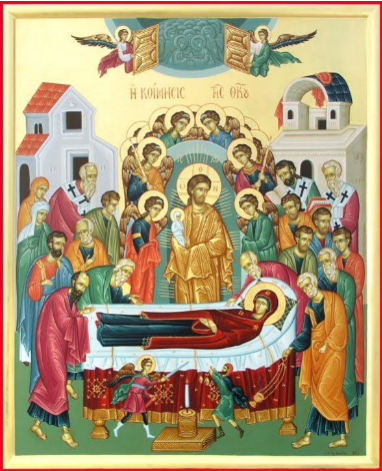
The Account of St. John the Theologian of the Falling Asleep of the Holy Mother of God is an apocryphal account of the dormition from a collection of writings known as the Transitus Mariae. Some scholars believe this collection to have been written in the late fourth or early fifth century,1 other sources place it in the second or third century.2 As with the Infancy Gospel of James, its apocryphal status does not mean that it is not a document of significant value. If nothing else, it is a good indicator of traditions in existence at the supposed time of its composition, as early as the second century. Incorporation of events it describes into the iconography affirms the value of its content.

The account tells of how the Apostles were brought together with the Mother of God at the time of her death and how her Son came to personally escort her soul into the heavens. After her soul had departed, the Apostles took up her body on a couch and carried it.

And, behold, while they were carrying her, a certain well-born Hebrew, Jephonias by name, running against the body, put his hands upon the couch; and, behold, an angel of the Lord by invisible power, with a sword of fire, cut off his two hands from his shoulders, and made them hang about the couch, lifted up in the air.3

This story has been compared to that of Uzzah. As mentioned above, when Uzzah reached out and touched the Ark, he was instantly killed. Another parallel exists between Jephonias and the idol of Dagon where the Ark was kept by the Philistines. During the second night of the Ark’s presence in Dagon’s temple, the idol of Dagon fell down and its hands were broken off (1 Samuel 5:4). It is notable that this event ended in a happy way, for, “at the word of Peter, the hands hanging by the couch of the Lady came, and were fixed on Jephonias. And he believed, and glorified Christ, God who had been born of her.”4

If you look closely at the icon, you can see Jephonias under the Holy Virgin with his hands floating about in the air, cut off by the sword the angel on the left is holding. The small white child being held by Christ is the Holy Virgin herself born again into the new life in Christ.

As with the Infancy Gospel of James, this gospel is not explicit about the typology of the Ark, but it is compatible with the hypothetical existence of such a tradition in the second century.

In our next post, we will begin a more lengthy series of twelve posts about the patristic witness to the Church’s understanding of the Ark of the Covenant. We will be examining what twelve of the Holy Fathers have to say about the Ark.


1 George Reid, Apocrypha, The Catholic Encyclopedia, Vol. 1, (New York: Robert Appleton Company, 1907).

Pope John Paul II, General Audience; Wednesday, 2 July 1997.

Translated by Alexander Walker, The Account of St. John the Theologian of the Falling Asleep of the Holy Mother of God, From Ante-Nicene Fathers, Vol. 8, Ed. Alexander Roberts, James Donaldson, A. Cleveland Coxe (Buffalo, NY: Christian Literature Publishing Co., 1886), Revised and edited for New Advent by Kevin Knight.

Ibid.

The Ark: Infancy Gospel of James

In our previous post, we diverged into a discussion of what typology is and why it matters. Here we return to the topic at hand, the Ark of the Covenant. Both this and the next post in this series will consider works that are sometimes called “apocrypha.” The Orthodox Church does not attach the same stigma to apocryphal works that many protestant traditions have, and while not part of the canon of scripture, many are still considered worthy of study.

The Infancy Gospel of James (this link to the work itself is a quick and interesting read), sometimes called the Protoevangelion of James, is an apocryphal gospel, likely from the second century, that was never accorded canonical status;1 which is not to say that it isn’t a document that has been valued in the Orthodox Church up until the present. This gospel demonstrates that the events celebrated by the Feast of the Entrance of the Theotokos were present in a very early tradition. We will discuss this feast, which continues to be celebrated annually by both the Catholic Church and the Orthodox Church, in a later post.

This gospel tells the story of the infancy and childhood of Mary the Mother of God. Of importance to the topic at hand are some allusions to her entrance into the Holy of Holies in the temple. The gospel tells how, at the age of three, her parents, Joachim and Anna, took her to the temple to be dedicated as a virgin to the service of God just as Hannah took the Prophet Samuel to the temple. The high priest received her, recognizing that the Lord would reveal His redemption through her. He placed her on the third step of the altar where she “danced with her feet.” In the gospel Mary is said to have been, “nurtured in the Holy of Holies, and received food from the hand of an angel.”2

(Some might wonder about having a girl in the temple, but the Scriptures themselves tell of the prophetess Anna, who “did not depart from the temple, but served God with fastings and prayers night and day” Luke 2:37 OSB).

What is striking is that, as we saw earlier, the Ark of the Covenant was no longer in the temple at this time, so the Holy of Holies was essentially empty when Mary entered it. Given this sequence of events, it would be unremarkable if readers of this gospel were to infer that the Holy Virgin had come at the appropriate time to replace the Ark of the Covenant as the dwelling place of God. While this gospel is certainly not explicit about such typology, it is compatible with the hypothetical existence of such a tradition in the second century, just as we found previously that there was enough potential allusion in the New Testament to allow for the theoretical existence of such an early tradition.

In the next post we will discuss the Account of St. John the Theologian of the Falling Asleep of the Holy Mother of God. If you’re interested in delving deeper into the Infancy Gospel, you can certainly follow the link above, but Frederica Matthewes-Greene has published a rather nice edition with her own commentary entitled, The Lost Gospel of Mary.


1 George Reid, Apocrypha, The Catholic Encyclopedia, Vol. 1, (New York: Robert Appleton Company, 1907).

2 Frederica Matthewes-Greene, The Lost Gospel of Mary, (Brewster, MA: Paraclete Press, 2007), P. 55.

Typology and Mythology

In our ongoing discussion (see also the previous post), we have been exploring the Church’s approach to understanding the Ark of the Covenant, or rather of understanding through the Ark of the Covenant. I’ve been talking about typology without explaining myself more fully. This post is a divergence from the main topic to help us come to grips with the whys and whats of typology.

A type is, in a sense, a kind of metaphor. For instance, Jonah is often considered a type of Christ in that he went down into the deepest parts of the earth for three days in the belly of a whale, only to rise again from the depths just as Christ rose from the dead.

A fundamental principle of an Orthodox hermeneutic is to read all scriptures, including the Old Testament, Christologically. An objection is often raised that this approach may violate the spirit of the text by reading something into it that is not there.

Modern readings of the Scriptures tend to focus on chronology, however, the authors of the Holy Scriptures were not simply recording history, but conveying a personal experience of God for posterity. Saint John Chrysostom explains that the Biblical authors “perceive with the eyes of the spirit things due to happen after a great number of years.”1 This perception implies something that goes beyond any intellectual endeavor, demonstrating a deep and direct experience of God.

Jesus Christ is the Lord of history. The Latin word vestigium means ‘footprint’. Our English derivative ‘vestiges’ has lost this hidden meaning, but it helps to paint a picture of God’s activity in history. God does not simply send written messages to his prophets to be delivered to His people. He actively leaves vestiges of himself throughout history. As the architect of history, Christ is able to leave his ‘footprints’ directly in the human timeline where the Biblical authors are able to perceive and experience them.

This experience of God is beyond an intellectual abstraction. In keeping with the ancient understanding of memory and imagination as foundational aspects of abstract thought, Unseen Warfare explains that “imagination is a power of the soul such that, by its very nature, it has no capacity for entering the realm of union with God.”2 Because this direct experience of God is not a rational abstraction, it cannot be conveyed by rational means such as direct exposition, but is established through the use of types.

I suggest that typology is akin to what C. S. Lewis calls myth. Lewis’s notion of myth did not coincide with the colloquial usage implying falsehood. Lewis believed that myth is somewhere between the intellectual and the purely experiential. As we noted earlier, purely intellectual endeavors have no capacity for entrance into a direct experience of God. On the other hand, pure experience does not bring understanding. Lewis advocated myth as a partial solution to this problem. He posited that, “In the enjoyment of a great myth we come nearest to experiencing as a concrete what can otherwise be understood only as an abstraction.”3 In a sense, myth can be seen to bridge the spiritual and the intellectual.

Typology thus provides the best and most natural approach through which to ‘tradition’, or pass on, the experience of the divine to following generations. Christ’s extensive and direct use of parables in his teaching affirms this mythological approach. Additionally, typology enables God to pedagogically ‘sneak’ up on truth. The Holy Spirit reveals Christ—truth—to mankind only inasmuch as mankind has the capacity to understand Him in its present state. A case in point is the Law of Moses, which Saint Paul likens to a tutor to bring us unto Christ (Galatians 3:24). Mankind was not yet ready to see Christ and so received a shadow of Christ as a step in its growth.

Saint John Chrysostom affirms that the Holy Spirit “explained everything to us by moving the author’s tongue in such a way as to take account of the limitations of the listeners.”4 Saint John demonstrates his point by drawing a potent parallel between the creation saga in the first chapter of Genesis and the first chapter of the Gospel of John, comparing the creation of light in Genesis with the enlightenment brought to the world through the true light, Jesus Christ the Word. In the time of Moses the world was not yet ready to receive the message delivered by John, but was able to catch a glimpse of the truth through the type present in Genesis.

The Scriptures and the ‘mythology’ portrayed therein pervaded the culture of Israel at the time of Christ and created an ethos of messianic anticipation. Saint John the Forerunner sent disciples to Jesus to confirm that in fact He was the Messiah whom all were anticipating (Luke 7:18-23). Jesus confirmed this truth by allowing John’s disciples to directly experience the fulfillment of prophecy (Isaiah 61:1). This event clearly demonstrates that the Jews of Christ’s time were anxiously awaiting a Messiah and Christ was actively fulfilling the promises set forth in Scripture.

To further reveal his intervention in history, Christ took unto himself certain names and titles (e.g. ‘Son of Man’) which He had planted in the Hebrew Scriptures so that He might connect Old Testament concepts and teachings with his earthly ministry.5 Frank Herbert’s missionaria protectiva would have been impressed. (You’ll get this reference if you’ve read Dune).

Before he ascended, Christ explicitly outlined to His disciples the things in the Scriptures that pertained to him. According to Saint Luke, “…beginning at Moses and all the prophets, he expounded unto them in all the scriptures the things concerning himself” (Luke 24:27 KJV). The disciples later observed that as He spoke to them, their hearts burned within them, again demonstrating an experience beyond rational thought.

The eastern approach to theology focuses less on a rational understanding of God and more on a direct mystical experience of God. The types present throughout the Old Testament pointing to a fulfillment in Christ help to bring about this near mystical understanding of our Lord Jesus Christ in a way that formal discourse is powerless to evoke. The apostolic and patristic fathers followed the tradition of Christ in their reading of Scripture, finding the footprints of God throughout.

In our next post, we’ll return to the Ark of the Covenant and begin to explore some lesser known ancient documents that help to shine some light on the Ark.


1 Saint John Chrysostom, Homily 10, in The Fathers of the Church, trans. Robert C. Hill, (Washington: Catholic University of America Press, 1986), vol. 74, pp. 132-133.

2 Lorenzo Scupoli, Unseen Warfare, trans. E. Kadloubovsky & G. E. H. Palmer (Crestwood, NY: St. Vladimir’s Seminary Press 1987), p. 148.

3 C. S. Lewis, Myth Became Fact.

4 Saint John Chrysostom, Homily 3, in The Fathers of the Church, vol. 73, p. 42.

5 Father John Breck, Scripture in Tradition, (Crestwood, New York: Saint Vladimir’s Seminary Press 2001), p. 34.

Ark of the Covenant in the New Testament

In part 2 of this series, we talked about the Ark of the Covenant in the Old Testament. Here we stroll into more ambiguous territory and attempt to find connections in places where they are not explicit. We focus on typological reference to the Ark. This part of the study is based on modern scholarship rather than on Biblical or Patristic sources. It’s far from certain, but still worthy of discussion. As mentioned at the beginning of this series, the Ark is often connected typologically to the virgin Mary, who is sometimes called the Ark of the New Covenant.

While the typology of the Ark is not directly mentioned in the Holy Scriptures, there exist several possible allusions that are worth discussing. A midrashic approach, exemplified by Fr. René Laurentin, attempts to find an intentional anamnesis embedded in Luke’s infancy narrative, intended to connect it with the Old Testament theme of God being present in the bosom of his people. First emerging in Exodus 33:3 and 34:9, it is developed throughout the Old Testament narrative, which progressively establishes the Ark as the epicenter of God’s presence in Israel.1

Fr. René finds numerous interesting textual parallels between Luke’s language and Ark-related imagery in the Old Testament. For instance, when God takes up residence in Israel, his glory overshadows the tabernacle (Exodus 40:35) just as the power of God overshadows the Holy Virgin as described by Gabriel during the Annunciation (Luke 1:35). In another case he compares David’s transfer of the Ark to Jerusalem (2 Samuel 6:2-11) with Jesus’ journey to Jerusalem in the womb of his mother (Luke 1:33-44).2

Fr. René surmises that Luke identified the events portrayed in his infancy narrative with the eschatological fulfillment of this theme as proclaimed by the Prophet Zephaniah. In this prophecy, the Daughter of Zion is thought to be the Holy Virgin and it is here that the typology of both the Ark and the Daughter of Zion converge, as we see God present in the bosom of His people:3

Rejoice greatly, O daughter of Zion! Cry aloud, O daughter of Jerusalem! Be glad and rejoice with your whole heart, O daughter of Jerusalem! The Lord thy God in the midst of thee is mighty; he will save, he will rejoice over thee with joy; he will rest in his love, he will joy over thee with singing (Zephaniah 3:14, 17).

A less ambiguous example is the Visitation narrative found in Luke 1:39-44. Elizabeth exclaims, “But why is this granted to me, that the mother of my Lord should come to me” (Luke 1:43)? This parallels David’s question, “In what possible way can the ark of the Lord come with me” (2 Samuel 6:9)? Similarly, Mary remains in the house of Elizabeth for three months just as the Ark remained in the house of Obededom for three months.4

Many in the Roman Catholic church find a connection between the Ark described at the end of chapter eleven of Revelation and the woman described in the beginning of chapter twelve. Chapter divisions were not present at the time of writing, so the two figures would have been seen tightly juxtaposed by earlier readers. Most of the Holy Fathers see this woman as a figure of the Church, but Cardinal John Henry Newman does not believe this precludes the woman from representing the Theotokos. He explains,

Now I do not deny of course that under the image of the Woman, the Church is signified; but what I would maintain is this, that the Holy Apostle would not have spoken of the Church under this particular image unless there had existed a Blessed Virgin Mary who was exalted on high and the object of veneration of all the faithful.5

In part 4, we’ll take a brief interlude from the topic at hand and discuss typology and why it matters.


François Bovon, Luke the Theologian: Fifty-five Years of Research (1950-2005), (Waco, TX: Baylor University Press, 2005), p. 182-185.

Ibid.

Ibid.

Michael O’Carroll, Theotokos: A Theological Encyclopedia of the Blessed Virgin Mary, <Eugene, OR: Wipf and Stock Publishers 2000>, p. 50.

Cardinal John Henry Newman, Modern History Sourcebook: John Henry Newman On the Blessed Virgin Mary, <15 March 2016>.