This is our final post in the series about how the Church views the Ark of the Covenant. In our previous post, we did some analysis on how the typology developed over time. Here I will share some thoughts on the implications of the fully developed typology. What does it mean?
As Robert Pirsig notes in the popular treatment of philosophy, Zen and the Art of Motorcycle Maintenance,
all you’ve got to work with is what you know. So your definition is made up of what you know. It’s an analogue to what you already know. It has to be. It can’t be anything else. And the mythos grows this way. By analogies to what is known before. The mythos is a building of analogues upon analogues upon analogues. These fill the collective consciousness of all communicating mankind. Every last bit of it.1
This mythos underlies the fabric of human consciousness. In the case of the nation of Israel, the relics and stories of the Old Testament formed a large component of the mythos that was woven into the collective consciousness. God, as the author of history, often writes history in such a way that it develops within the mythos the things that will be necessary to help understand and articulate what is to come. This mythos, as the collection of what early Jewish Christians knew, formed the basis of new definitions and a deepening articulation of the gospel in the patristic age.
But typology is more than just a method of definition. I suggest that typology is akin to what C. S. Lewis calls myth. Lewis believed that myth is somewhere between the intellectual and the purely experiential. In traditional usage, memory and imagination are aspects of abstract intellectual thought. Unseen Warfare explains that “imagination is a power of the soul such that, by its very nature, it has no capacity for entering the realm of union with God.”2 It follows that purely intellectual endeavors have no capacity for entrance into a direct experience of God. On the other hand, pure experience does not bring understanding. Lewis advocated myth as a partial solution to this problem. He posited that, “In the enjoyment of a great myth we come nearest to experiencing as a concrete what can otherwise be understood only as an abstraction.”3 In a sense myth, and perhaps typology, can be seen to bridge the spiritual and the intellectual.
This way of defining what the Holy Virgin is is a tool to help us understand, not only on an intellectual level, but on a spiritual level as well. Likewise, though the Church emphasizes it less, talking about the Ark as a type of Christ teaches us certain things about Christ on both a spiritual and intellectual level. Neither typology is wrong per se, but the Church, in her wisdom, has chosen to emphasize the Ark as a type of the Theotokos.
The understanding conveyed by typology cannot be obtained through an intellectual discourse such is this. We can certainly discuss aspects of its meaning, but it must be experienced. Perhaps the best place to begin an experience of this typology is participation in the feasts of the Church. As Saint Jerome extended the metaphor of the Ark to the monastic life, the late Protopresbyter Thomas Hopko extended the metaphor to everyone. In his discussion of the feasts he explains:
Thus, the feast of the Entrance of the Theotokos into the Temple is the feast which celebrates the end of the physical temple in Jerusalem as the dwelling place of God. When the child Mary enters the temple, the time of the temple comes to an end and the “preview of the good will of God” is shown forth. On this feast we celebrate-in the person of Christ’s mother-that we too are the house and tabernacle of the Lord.4
1 Robert M. Pirsig, Zen and the Art of Motorcycle Maintenance, (New York, NY: HarperTorch, 2006), Ch. 28.
2Lorenzo Scupoli, ‘Unseen Warfare,’ trans. E. Kadloubovsky & G. E. H. Palmer (Crestwood, NY: St. Vladimir’s Seminary Press 1987), p. 148.
3 S. Lewis, ‘Myth Became Fact’.
4 Protopresbyter Thomas Hopko, The Orthodox Faith, volume 2, (https://oca.org/orthodoxy/the-orthodox-faith/worship/the-church-year/entrance-of-the-theotokos-to-the-temple).


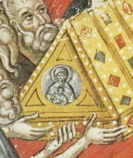 Iconography depicting the Ark almost universally incorporates an emblem of the Theotokos upon the Ark itself. In the 16th century icon of the exaltation of the Ark by Master Theophane of Crete above, you see a circular emblem depicting the Theotokos both on the end of the Ark and at the end of the table upon which the Ark rests. You can see a closeup of the emblem on the Ark at right.

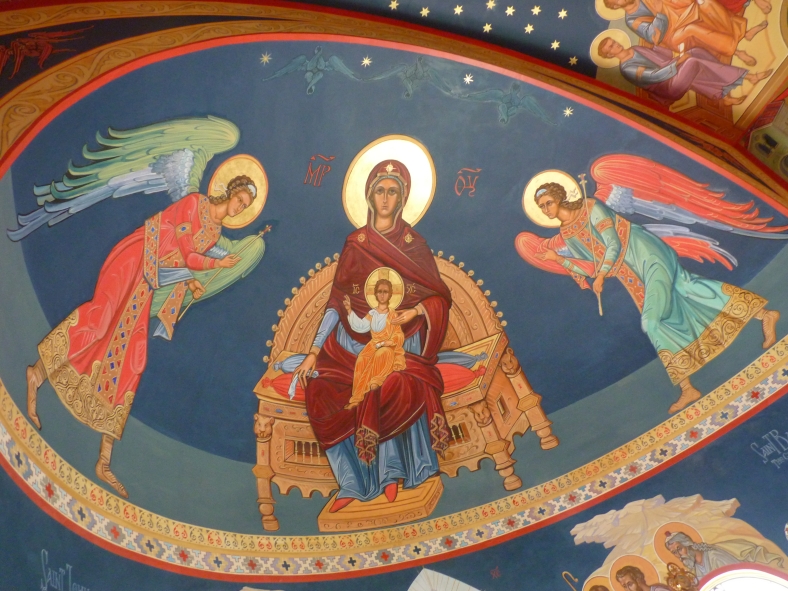
 The photo on the right from the
  The feast of the entrance recalls our previous
 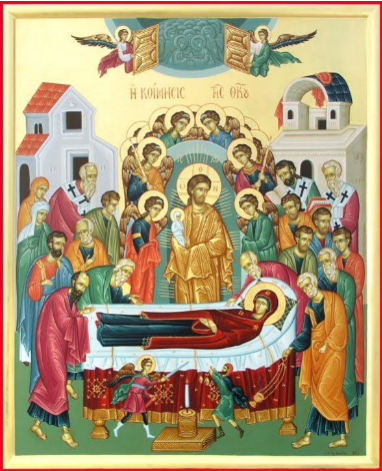 The Dormition of the Theotokos is perhaps the most explicit of the feasts of the Church when articulating the typology of the Ark of the Covenant. In one set of troparia, the story of the Dormition as related by
  Saint Cyril, the twenty-fourth patriarch of Alexandria, lived from 376-444. Saint Cyril seems to hearken back to the tradition exemplified by Saint Irenaeus, but with some additions. The pattern of his statement very closely mirrors
  Saint John, born in A.D. 676, wrote the famous Canon of Pascha that is sung during the Orthodox Pascha services. In the Canon, Saint John doesn’t seem to commit to a specific typological relationship for the Ark. His intention seems to be to expose the contrast between human experience of the types and human experience of the fulfillment.
 In our
  Saint Ambrose, living from 340-397, provides perhaps the clearest “rationale” for seeing the Ark as a type of Mary. He draws a number of parallels between the Ark and the Virgin in which those applied to the Virgin exceed those of the Ark. He contrasts the Law with the Gospel, the voice of God with the Word of God, and the glitter of gold with the splendour of virginity.
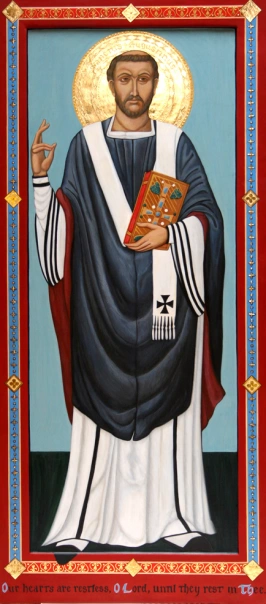 Saint Augustine, living from A.D. 354-430, seems to be one of the few among his contemporaries who holds the Ark to be a type of the Church as the body of Christ rather than a type of the Virgin Mary. The very passage that Saint Gregory Thaumaturgus earlier interpreted as speaking of the Holy Virgin, Augustine interprets as referring to the Church.
  Now we come to one of my favorite parts of our
 In our
  parochianus