In my studies with the Saints Cyril and Athanasius Institute for Orthodox Studies, after reading The Basis of the Social Concept of the Russian Orthodox Church, I was assigned to answer the question, “Which social issue do you find most challenging or troubling in its treatment in the document, and why?” I’d like to share my response here.
Because I am personally intrigued by the idea of organ transplantation, I found section XII.7 to be particularly interesting, though I am concerned that it may not have gone far enough in some cases. The document does do a good job addressing all the salient points surrounding the issue of transplantation. The key points I identify are:
- The ability to improve or extend life
- The creation of a black market for organs
- The will of the donor
- Identification of the moment of death
- The integrity of the personal identity of the recipient
- The growing of fetuses for the purpose of organ donation
Transplantation of organs can be a blessing. An excellent example of a type of transplantation that improves the quality of life of the recipient is a cornea transplant. I have personally known a person who received a cornea transplant and his life was demonstrably improved. Consequently, I cannot make the case that organ transplantation is universally immoral. It does enable doctors to express compassion through healing.
I do believe that each of the six points above are addressed adequately, carefully, and mercifully in the document with the exception of item 5. The document states that, “in no circumstances moral justification can be given to the transplantation that threatens the identity of a recipient, affecting his uniqueness as personality and representative of a species.” I believe that this articulation is good as far as it goes. But I believe that it should have contained more detail rather than leaving the interpretation up to the judgement of doctors.
While modern medicine, rooted in reductionist thinking, does not see a link between personality and most organs other than the brain, medicine has not always held this position. Traditional Chinese Medicine (TCM), for instance, links various aspects of a personality to specific organs. For example, difficulty in making decisions is usually attributed to gallbladder issues. Worry is often linked to issues of the spleen. TCM is not unlike its ancient European counterparts. In Hippocratic medicine, the four humors (as opposed to organs) give rise to four temperaments. While modern medicine generally discards these paradigms as being rooted in ignorance, we continue to find that treatment modalities such as acupuncture established by these forms of medicine continue to be effective. Furthermore, the Fathers of the Church clearly teach that the nous resides in the heart. These ancient teachings raise questions about the spiritual impact of a heart transplant or even of blood transfusions.
Not only do we have traditional approaches to medicine and some teachings of the Fathers creating questions about transplantation, but there exists anecdotal evidence together with some scientific theories that call into question the belief that the heart is merely a pump. People have experienced personality change. While our contemporaries are astounded at such a notion, the ancients would probably have asked sarcastically, “what did you expect?”
These views are generally considered pseudoscience by mainstream scientists. Then again, frontal lobotomies were mainstream in the ’40s and ’50s, but are now banned in many countries on moral grounds. There have been enough questions raised for me to be concerned. And, the burden of proof lies upon the advocates of transplantation. Many who call themselves skeptics criticize what they believe to be a pseudoscientific explanation for personality transference. I consider myself a skeptic of the belief that transplantation does not impact the identity of the recipient and that the heart is merely a pump.
The following video poses interesting questions about heart transplants in particular.
 In my
In my 
 In our
  Growing up Seventh-day Adventist (SDA), I knew this passage well as a proof text demonstrating the “state of the dead.” I believed that when I died, even if I died “in Christ,” I would in essence cease to exist until the general resurrection of the dead on the “last” day.
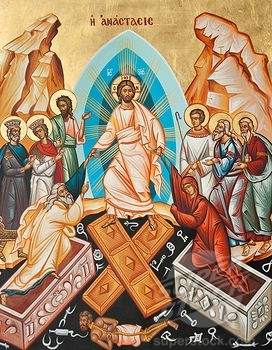
 What is striking to me about this image is not only the use of light to draw the eye to key points, but realism blended with the surreal. The characters have a three-dimensionality and detail, that while not quite photographic, is starkly contrasted with Orthodox iconography. And yet, the realism seems incongruous with the unbelievability of the scene. The image portrays what seems to me to be extreme chaos. The chaos revolves around the central figure of Christ who seems to anchor reality in place.
 On the right, you will find a fairly typical Orthodox icon representing the Biblical account of the resurrection of Lazarus.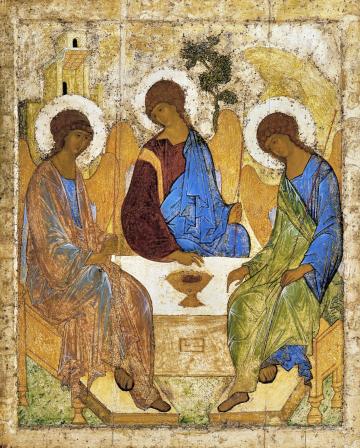
 The Rublev icon is generally seen to be the ultimate evolution of the iconographic representation of the Old Testament Trinity. However, it appears that the iconographic tradition lagged behind the patristic tradition. Bunge claims that depictions of the story were from the beginning angelological1
