The Hospitality of Abraham: From Christ to Trinity

mosaic-panel-2-abe-angels

Mosaic from the Papal basilica of Santa Maria Maggiore in Rome, c. 5th century

In our previous post, we found that the earliest understanding of the story of the Hospitality of Abraham was that the three visitors were angels. It didn’t take long for interpretation of this story to develop.

Saint Justin expresses an alternative view in his Dialog with Trypho. Trypho believes, as do his contemporary Jewish brethren, that God spoke to Abraham immediately prior to the appearance of the three visitors and that the visitors were merely angels. Justin argues directly from the Scriptures “that one of the three, who is both God and Lord, and ministers to Him who is in the heavens, is Lord of the two angels.”1 Justin understands the central figure of the triad to be the Son of God and those accompanying him to be angels. Saint Irenaeus corroborates Justin’s position, asserting that “two of the three were angels; but one was the Son of God…”2

Though Novatian apostatized, he provides witness to the fact that Justin’s view on Abraham’s visitation persisted in the third century. In his Treatise on the Trinity he writes, “It was not the Father, then, who was a guest with Abraham, but Christ. Nor was it the Father who was seen then, but the Son; and Christ was seen.”3

Saint Ephraim the Syrian provides fourth century confirmation of the Christological understanding of the three persons. In his commentary on Genesis he explains, “Therefore, the Lord, who had just appeared to him at the door of the tent, now appeared to Abraham clearly in one of the three.”4

While the earliest view may have been purely angelological, the bulk of the patristic witness up to this point seems to have been consistently Christological. The Church’s understanding of this theophany seems to begin evolving later in the fourth century as both Saints Ambrose and Augustine begin to see this triad as a type of the Holy Trinity.

Saint Ambrose explicitly recognizes that the appearance of the three is a type. He also perceives Trinitarian significance in the cardinalities of both the sacrifice and the gifts offered to the three.

Abraham… saw the Trinity in a type… beholding Three he worshipped One, and preserving the distinction of the Persons, yet addressed one Lord, he offered to Three the honour of his gift, while acknowledging one Power… and so he sees Three, but worships the Unity. He brings forth three measures of fine meal, and slays one victim, considering that one sacrifice is sufficient, but a triple gift; one victim, an offering of three.5

Saint Augustine followed his mentor in a similar vein, asserting more resolutely that the presence of God in the three visitors was typological. Justin had earlier argued that one of the three was Christ as evidenced by the fact that Abraham addressed the three as one. Augustine argues, specifically countering Justin’s argument, that no particular person of the three was Christ, but all three were angels. He observes that the same phenomenon occurred when Lot addressed only two as one while the third remained with Abraham. Augustine supports an iconic presence, arguing that:

This makes it much more credible that both Abraham in the three men and Lot in the two recognized the Lord, addressing Him in the singular number, even when they were addressing men… Yet there was about them something so excellent, that those who showed them hospitality as men could not doubt that God was in them as He was wont to be in the prophets…6

In our next post, we will examine a more refined expression of this understanding in the writings of Saints Cyril and Maximus.


1 Justin Martyr, ‘Dialog with Trypho’, trans. Messrs. Dods and Reith, in The Apostolic Fathers with Justin Martyr and Irenaeus (http://www.ccel.org/ccel/schaff/anf01.viii.iv.lvi.html) , ed. Philip Schaff, Christian Classics Ethereal Library, Calvin College, ch. 56.

2 Peter Kirby. “A Discourse in Demonstration of the Apostolic Preaching,” in Early Christian Writings (http://www.earlychristianwritings.com/text/demonstrationapostolic.html) .

3 Novatian, ‘A Treatise of Novatian Concerning the Trinity,’ trans. Rev. Robert Ernest Wallis, in Ante-Nicene Fathers, (http://www.ccel.org/ccel/schaff/anf05.vi.iii.xix.html) , ed. Philip Schaff, Christian Classics Ethereal Library, Calvin College, ch. 18.

4 Saint Ephraim the Syrian, ‘Selected Prose Works,’ trans. Edward G. Matthews, Jr. and Joseph P. Amar, in The Fathers of the Church, ed. Kathleen McVey (Catholic Univ of Amer Pr 1994), v. 91, s. 15, pars. 1, p. 158.

5 Saint Ambrose of Milan, ‘Selected Works and Letters,’ trans. The Rev. H. De Romestin, in Nicene and Post-Nicene Fathers, Series 2, volume 10, (http://www.ccel.org/ccel/schaff/npnf210.iv.iii.iii.html#iv.iii.iii-p203) , ed. Philip Schaff, Christian Classics Ethereal Library, Calvin College,  pars. 96.

6 Saint Augustine, ‘The City of God,’ trans. Rev. Marcus Dods, D.D., in Nicene and Post-Nicene Fathers, Series 1, Volume 2 (http://www.ccel.org/ccel/schaff/npnf102.iv.XVI.29.html) , ed. Philip Schaff, Christian Classics Ethereal Library, Calvin College, Book 16, ch. 29.

The Hospitality of Abraham: Intro

rublev_troitsaHaving wrapped up my diatribe on the Ark of the Covenant and its typology, I thought it might be worth a short series focusing on the typology attached to the story of Abraham’s hospitality. The typology follows a pattern similar to that of the Ark and might help to deepen our understanding of how typology develops within the Church.

What Orthodox person has not experienced Saint Andrei Rublev’s icon of the Holy Trinity? This icon is a depiction of the three visitors in the Genesis 18 story of Abraham’s hospitality, but to the nominal Orthodox person the icon itself may be the sole witness to Abraham’s encounter with God at Mamre. And yet, Saint Constantine considered the event to be so important that he ordered a temple to be erected near the famous oak tree at Mamre.1

While the icon may be the strongest witness experienced during the course of life in the church, a long patristic tradition witnesses to an image of God in the threefold visitation of Abraham. A prominent, though subtle, witness exists in the liturgical cycle of the church. The bulk of this short study will focus on the ‘Great Conversation’ of the Fathers, moving on to a short overview of the liturgical expression, and a brief analysis of Rublev’s icon and the related tradition.

Perhaps the earliest Christian understanding of Genesis 18 is that all three of the visitors in the story were angels. Saint Paul suggests this in his Letter to the Hebrews when he admonishes, “Be not forgetful to entertain strangers: for thereby some have entertained angels unawares” (Hebrews 13:2 KJV).2

In the next post in this series we will follow a shift from this angelological understanding to a more Christocentric understanding.


1 Sozomen, ‘The Ecclesiastical History of Sozomen,’ revised by Chester D. Hartranft, in Nicene and Post-Nicene Fathers, Series 2, Volume 2 (http://www.ccel.org/ccel/schaff/npnf202.iii.vii.iv.html) , ed. Philip Schaff, Christian Classics Ethereal Library, Calvin College, Book 2, ch. 4.

2 Gabriel Bunge, “The Rublev Trinity,” trans. Andrew Louth, (Yonkers: Saint Vladimir’s Seminary Press 2007), p. 46.

The Ark: Conclusions

This is our final post in the series about how the Church views the Ark of the Covenant. In our previous post, we did some analysis on how the typology developed over time. Here I will share some thoughts on the implications of the fully developed typology. What does it mean?

As Robert Pirsig notes in the popular treatment of philosophy, Zen and the Art of Motorcycle Maintenance,

all you’ve got to work with is what you know. So your definition is made up of what you know. It’s an analogue to what you already know. It has to be. It can’t be anything else. And the mythos grows this way. By analogies to what is known before. The mythos is a building of analogues upon analogues upon analogues. These fill the collective consciousness of all communicating mankind. Every last bit of it.1

This mythos underlies the fabric of human consciousness. In the case of the nation of Israel, the relics and stories of the Old Testament formed a large component of the mythos that was woven into the collective consciousness. God, as the author of history, often writes history in such a way that it develops within the mythos the things that will be necessary to help understand and articulate what is to come. This mythos, as the collection of what early Jewish Christians knew, formed the basis of new definitions and a deepening articulation of the gospel in the patristic age.

But typology is more than just a method of definition. I suggest that typology is akin to what C. S. Lewis calls myth. Lewis believed that myth is somewhere between the intellectual and the purely experiential. In traditional usage, memory and imagination are aspects of abstract intellectual thought. Unseen Warfare explains that “imagination is a power of the soul such that, by its very nature, it has no capacity for entering the realm of union with God.”2 It follows that purely intellectual endeavors have no capacity for entrance into a direct experience of God. On the other hand, pure experience does not bring understanding. Lewis advocated myth as a partial solution to this problem. He posited that, “In the enjoyment of a great myth we come nearest to experiencing as a concrete what can otherwise be understood only as an abstraction.”3 In a sense myth, and perhaps typology, can be seen to bridge the spiritual and the intellectual.

This way of defining what the Holy Virgin is is a tool to help us understand, not only on an intellectual level, but on a spiritual level as well. Likewise, though the Church emphasizes it less, talking about the Ark as a type of Christ teaches us certain things about Christ on both a spiritual and intellectual level. Neither typology is wrong per se, but the Church, in her wisdom, has chosen to emphasize the Ark as a type of the Theotokos.

The understanding conveyed by typology cannot be obtained through an intellectual discourse such is this. We can certainly discuss aspects of its meaning, but it must be experienced. Perhaps the best place to begin an experience of this typology is participation in the feasts of the Church. As Saint Jerome extended the metaphor of the Ark to the monastic life, the late Protopresbyter Thomas Hopko extended the metaphor to everyone.  In his discussion of the feasts he explains:

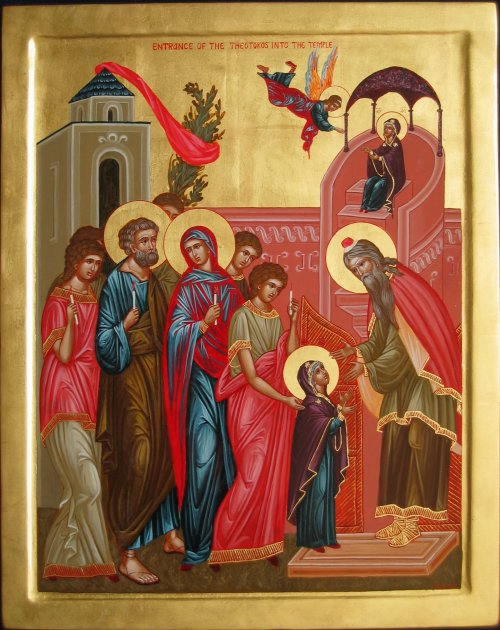
Thus, the feast of the Entrance of the Theotokos into the Temple is the feast which celebrates the end of the physical temple in Jerusalem as the dwelling place of God. When the child Mary enters the temple, the time of the temple comes to an end and the “preview of the good will of God” is shown forth. On this feast we celebrate-in the person of Christ’s mother-that we too are the house and tabernacle of the Lord.4


1 Robert M. Pirsig, Zen and the Art of Motorcycle Maintenance, (New York, NY: HarperTorch, 2006), Ch. 28.

2Lorenzo Scupoli, ‘Unseen Warfare,’ trans. E. Kadloubovsky & G. E. H. Palmer (Crestwood, NY: St. Vladimir’s Seminary Press 1987), p. 148.

3 S. Lewis, ‘Myth Became Fact’.

4 Protopresbyter Thomas Hopko, The Orthodox Faith, volume 2, (https://oca.org/orthodoxy/the-orthodox-faith/worship/the-church-year/entrance-of-the-theotokos-to-the-temple).

Blessing the Waters

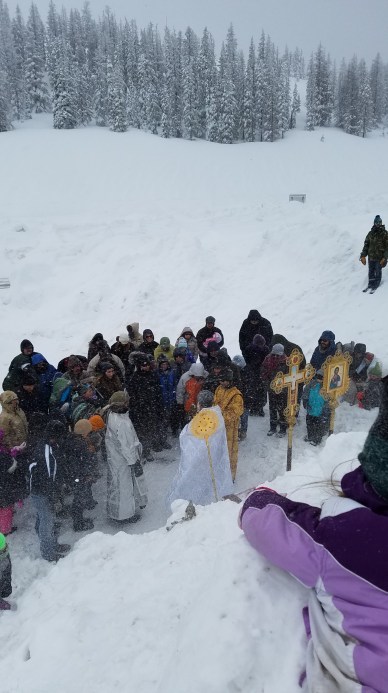
20170116_113258Given my general focus on typology on this blog, I thought it apropos to say something about the typology evident in the Orthodox feast of Holy Theophany (our parish’s patronal feast), or Christ’s baptism. Today our family made the trek with many others from our parish to the continental divide at Monarch Pass to participate in the blessing of the waters that traditionally follows the feast. It was rather cold and blustery, but a blessing that extends to both sides of the continent. The water blessing typically takes place on the day of the feast, but we delayed this particular event to make it easier for more to attend.
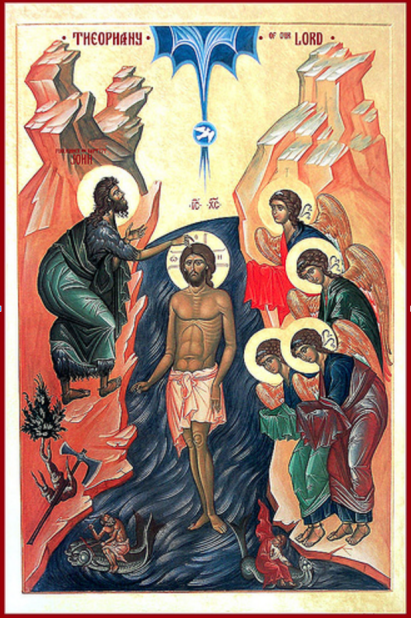
A glimpse of the magnitude interdependence between the two Testaments can be experienced through even a cursory examination of the feast of Holy Theophany, since so many Old Testament types foreshadow baptism. Saint Mark’s account of Christ’s baptism sets the stage for the blessing of the waters following the Divine Liturgy. Leading up to the blessing, prophecies from the book of Isaiah proclaim the coming of the Messianic age, repeatedly employing the imagery of water satiating the thirst of that which is dry, transforming deserts into oases.

Immediately before the enactment of the blessing, we encounter four Old Testament types prefiguring the baptism of our Lord.

You are our God, who drowned sin in the waters at the time of Noah.

You are our God, who in the sea, and at the hands of Moses, delivered the Hebrews from the bondage of Pharaoh.

You are our God who cleaved the rock in the wilderness, so that the waters gushed out, and the streams overflowed, and your thirsty people were satisfied.

You are our God who, with fire and water and at the hands of Elijah, delivered Israel from the errors of Baal.1

These verses awaken the memory of the previous night’s services (usually) incorporating Old Testament passages that illustrate some of these and other types in detail. For instance, excerpts from Exodus 14 portray the miraculous Israelite crossing of the sea and the devastating destruction of their Egyptian pursuers in the waters of the sea, clearly in agreement with Saint Gregory’s typology in The Life of Moses. The story of the Prophet Elias defeating the prophets of Baal is conveyed through the reading of 1 Kings 18:30-39.2

screen-shot-2017-01-16-at-3-00-54-pmDuring these evening services, the reality of Theophany is explicitly connected with the events described in these ancient Scriptures by the Apostle Paul:

Moreover, brethren, I would not that ye should be ignorant, how that all our fathers were under the cloud, and all passed through the sea; And were all baptized unto Moses in the cloud and in the sea; And did all eat the same spiritual meat; And did all drink the same spiritual drink: for they drank of that spiritual Rock that followed them: and that Rock was Christ (1 Corinthians 10:14).

Recalling the day’s Liturgical Epistle reading of Titus 2:11-14, we learn of the consequences of Theophany. God came to earth so “that he might redeem us from all iniquity, and purify unto himself a peculiar people, zealous of good works.” It seems that the Old Testament foretells the event, the Gospel narrates the event itself, while the Epistle exposes the outcome.3

Finally, when the celebrant enacts the blessing upon the water, he immerses the Cross into the water three times (ok, ours was snow), evoking the reading of Exodus 15 from the previous evening telling the story of the waters of Marah. The wood that sweetened the waters of Marah clearly foreshadows the wood of the cross and the cleansing of the water in Christ’s baptism. But the act also typifies Christ’s baptism and unites the types and their antetype into a single physical action, immersing the participants in a direct experiential encounter with the reality.

The Church, in the troparion of the feast and in the icon of the feast, elucidates the ultimate revelation of Theophany. The Trinity, which we saw foreshadowed in Elijah’s threefold baptism of his sacrifice, is fully apprehended in both the icon and the Troparion, clearly portraying the Gospel event. The icon depicts the glory of the Father sending down the Holy Spirit in the form of a dove to Christ who stands in the Jordan, the river parted so many times by Christ himself. The troparion makes the understanding explicit:

When Thou, O Lord, wast baptized in the Jordan the worship of the Trinity was made manifest! For the voice of the Father bare witness to Thee, calling Thee his Beloved Son. And the Spirit, in the form of a dove, confirmed the truthfulness of his Word. O Christ our God, who hast revealed Thyself and hast enlightened the world, glory to Thee.4

In this feast Old Testament passages are used in multiple ways. We experience prophecy or promise, as in the Prophecies of Isaiah, pointing to the fulfillment in the Baptism of Christ and in our own baptisms in Christ. We also experience the antetype through a rich portrayal of Old Testament types, partly in the words of the blessing itself, but more fully in the prior evening’s services. Gospel passages portray the antetype itself and Epistle readings explicitly connect the types with their antetype in order to provide clarity. The Epistle readings also help to explain the consequences of Theophany. Finally, all are united experientially in the liturgical action of the blessing of the waters and in the depiction of the event in the Holy Icon.

The Gospel seems to be the vortex around which all other scriptures swirl. The event of Theophany impacts both the past and the future, sending ripples in all directions through the fabric of space-time. The experience of the feast itself is outside of time and we experience it through direct participation.


1 John Sanidopoulos, “The Theophany Sanctification Prayer of St. Sophronios of Jerusalem”, Mystagogy: The Weblog of John Sanidopoulos (http://www.johnsanidopoulos.com/2011/01/theophany-sanctification-prayer-of-st.html) .

2 “Readings for Theophany – January 6”, Byzantine Catholic Church in America (http://www.byzcath.org/etc/Theophany_Readings.pdf) .

3 Fr. Thomas Hopko, “Epiphany”, in The Orthodox Faith: Volume II – Worship (http://oca.org/orthodoxy/the-orthodox-faith/worship/the-church-year/epiphany) .

4 Ibid.

The Ark: Typological Development

screen-shot-2017-01-13-at-9-45-55-am

Iconography in the Apse of Holy Theophany Church in Colorado Springs.

We are beginning to wrap up our ongoing discussion of how the Church views the Ark of the Covenant. We have covered many concrete examples and are now embarking on some analysis of what we have learned.

We have traced how the people of God have understood the ark from its very beginning to its contemporary expression within the Church. We have examined how the Ark was built and we followed its life in Israel up until its disappearance. Subsequently, we examined possible midrashic traditions latent in Scripture that typologically identify the Ark with the Holy Virgin. We examined so-called apocryphal literature that provides useful clues. We traced the great conversation of the Holy Fathers on this topic through the first seven centuries. And finally, we examined the expression of the Ark’s typology in the life of the Church: its iconography, services, and hymnology.

In this particular case study, and perhaps others, we find a distinct pattern. First, the subject of typological interest comes into existence. In our case, the Ark is explicitly “spec’d out” by God himself and is then constructed under the guidance of the Prophet Moses. The Ark gains a certain mystique throughout its developing life among the people of Israel, becoming a key emblem or meme in the mythos of the nation of Israel. Whether we are talking about a physical artifact such as the Ark or a story such as Abraham’s hospitality to his three visitors (a topic for an upcoming series of posts), the type follows this same path.

The next step is the Gospel. Saint Paul alludes to the application of forward looking typology to the Old Testament, saying, “For the law having a shadow of good things to come, and not the very image of the things, can never with those sacrifices which they offered year by year continually make the comers thereunto perfect” (Hebrews 10:1). In our specific case, it is affirmed by Saint John Damascene as noted earlier. The Gospel becomes the lens that we use to interpret the ancient types, but the interpretation does not necessarily become clear immediately, as in our case.

Clearly, given the fact that accounts of the Gospel and other contemporaneous events were recorded significantly later, either an oral tradition or long lost documents carry the stories forward in time until they are written down. Interpretations may grow organically within this mix, as hypothesized by Laurentin and others, influencing the recording of Scripture and other writings.

We begin to truly see the application of typology surface in the writings of the Holy Fathers, where it develops through the centuries. As the present author might observe from a similar study of the typology attached to the story of the Hospitality of Abraham, a turning point in the application of the typology seems to sometimes occur during the third or fourth centuries. It is probably not coincidental that this was a time of great upheaval and development within the church, owing to the occurrence of many heresies and the refining of doctrinal articulation that was carried out by the great ecumenical councils. In our case we see a transition from a clearly Christocentric typology of the Ark to its identification with the Holy Virgin Mary (the shift seems to happen somewhere between Saint Dionysius and Saint Athanasius). While both typological traditions may have coexisted from very early times, the Church shifted emphasis from one to the other as its understanding deepened.

The title Theotokos is not truly rooted in Mariology, but in Christology. It does honor to the Theotokos by recognizing her role in the incarnation, but she is called the God Bearer not due to her own nature, but because of the nature of her son. The ecumenical councils sought to clarify the nature of Jesus Christ and this clarification shone light also upon the role of Mary, which may have influenced how the Church viewed the typology of Mary and of the Ark.

After the conciliar age, the typology seems to stabilize and we see it becoming part of Orthodox praxis in the services of the Church as described above. Iconography finally incorporates the typology and we not only hear it in the hymnology, but see it on the walls of the church. In the end, lex orandi, lex credendi: the law of praying is the law of believing.

Here we have discussed the implications of theological/typological development within the church. In our next post in this series, we will discussion the implications of the fully developed typology.

The Ark: Iconography

In our ongoing discussion of how the Church treats the Ark of the Covenant, we have covered a lot of ground. We have examined the Old and New Testaments, apocryphal works, the writings of the Holy Fathers, and Liturgical treatment of the Ark. In this installment, we will discuss how the Ark is portrayed in the iconography of the Church. This will be the final installment in which we explore concrete examples. Subsequent posts will focus on a discussion of the impact of what we have learned.

screen-shot-2017-01-04-at-9-22-20-am

screen-shot-2017-01-04-at-9-36-39-amIconography depicting the Ark almost universally incorporates an emblem of the Theotokos upon the Ark itself. In the 16th century icon of the exaltation of the Ark by Master Theophane of Crete above, you see a circular emblem depicting the Theotokos both on the end of the Ark and at the end of the table upon which the Ark rests. You can see a closeup of the emblem on the Ark at right.

In the icon below depicting Uzzah dying, you can again see the emblem of the Theotokos on the end of the Ark. Uzzah is lying on the ground off to the side of the Ark after he incorrectly touched the Ark. To the left, King David dances before the Ark.

screen-shot-2017-01-04-at-9-30-07-am

In a much clearer illustration of the typology, the French icon by Agnes Glichitch of David dancing before the ark on the right portrays the Theotokos very prominentldaviddansant-08y over the center of the Ark.

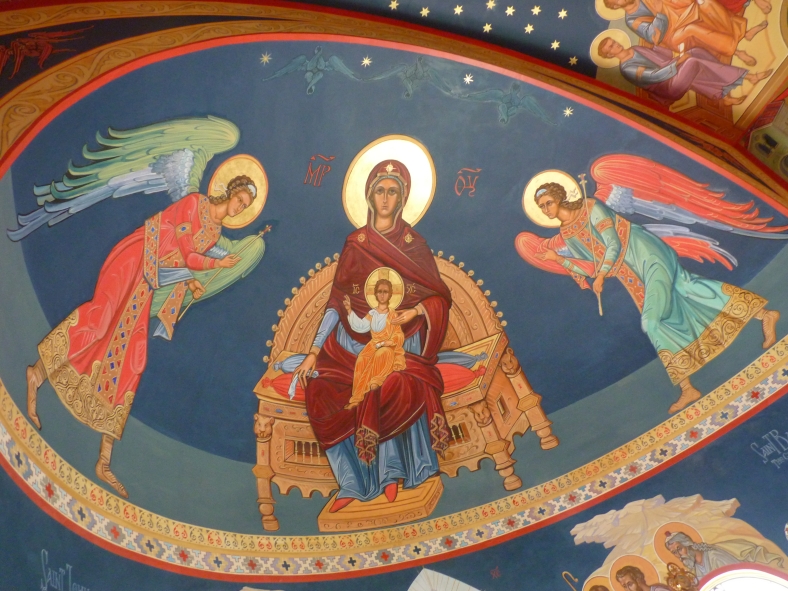
In the apse above the altar of Holy Theophany Orthodox Church in Colorado Springs, Colorado (my home parish), is an icon of the Most Holy Theotokos depicted in her role as Ark. Portrayed in the photo below, you can see the angels on either side, just as they were in the Mosaic Ark, along with the Mother of God in the center. Just as in Moses’ time God’s presence rested on the mercy seat above the Ark, His presence sits upon His mother. The icon is located immediately above the high place in the sanctuary just as the Old Testament Ark resided in the most holy place of the temple.


p1110020

screen-shot-2017-01-04-at-9-55-12-amThe photo on the right from the Stanislaus Kostka Roman Catholic Church in Chicago quite stunningly and very unambiguously illustrates this typology, representing the divine presence as the radiant circle in the heart of the virgin, just as she bore and bears the Word of God within her. This circle is where the Holy Eucharist is reserved.

In our next installment in this series, we will discuss the development of the typology of the Ark of the Covenant from its beginning to today and the implications of how it has developed.

Judith: Chapter 5 Translated

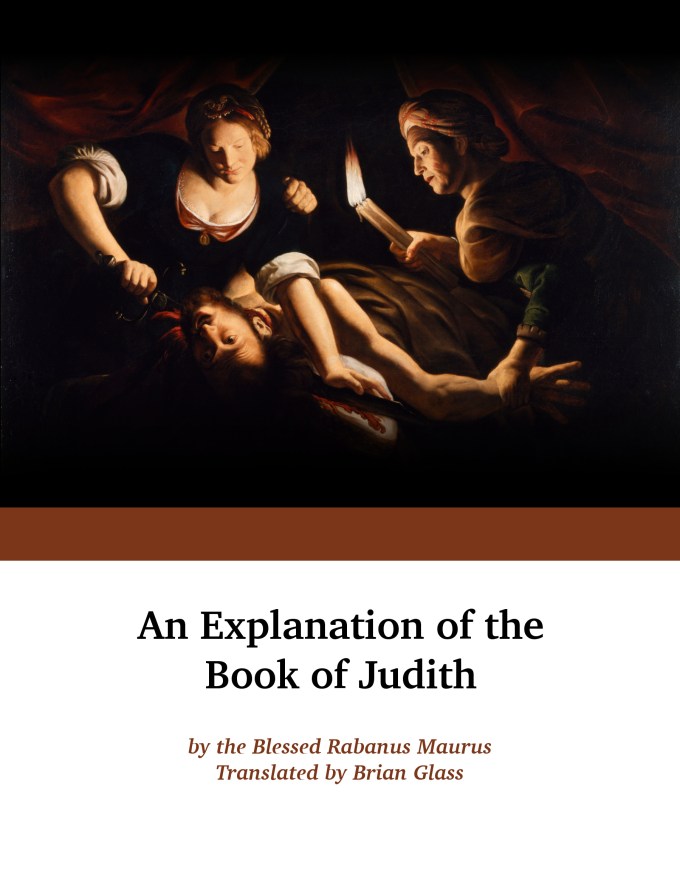
judith_beheading_holofernes_by_caravaggio

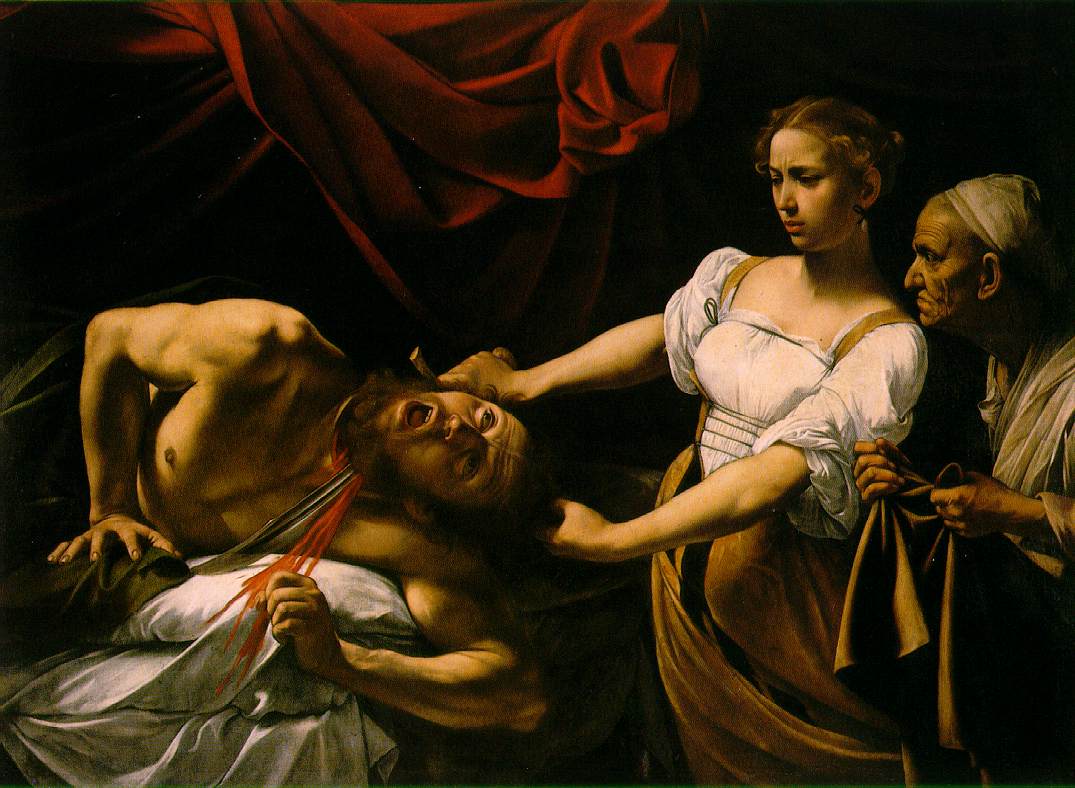
Caravaggio, Judith Beheading Holofernes, 1598—1599.

I am pleased to report that I have completed the draft of chapter 5 of Rabanus Maurus’ commentary on the book of Judith.

In chapter 5 we meet Achior, a heathen who seems to know the story of Israel quite well and warns Holofernes and his leaders that they won’t likely be able to defeat Israel. Holofernes and his leaders don’t take kindly to this warning and threaten to kill Achior for suggesting that anyone is greater than Nabuchodonosor (Nebuchadnezzar).

Early in the chapter, Rabanus likens Achior to a heretic who, while he speaks words of truth, also mixes error in with that truth. Later Achior is likened to the ten lepers cleansed by Christ. The white spots intermingled with the healthy skin represent error intermixed with truth, yet Christ cleanses the lepers. By the end of the chapter Achior is related to the man born blind from birth to whom Jesus granted sight. Even further, Rabanus connects the Jews who ejected the blind man from the temple with Holofernes’ phalanxes. But Achior, choosing the discipleship of Christ, and more literally being circumcised in the flesh and joined to the people of Israel, has chosen the correct side, being converted from his heathen ways.

Rabanus compares Holofernes and his men to those who “take pride in worldly arrogance” and who on the one hand:

look down from outside upon “men unarmed and without force,” being unable to look inwardly at the force of spirit and virtue of faith by which they fight invisibly against spiritual enemies; on the other hand these, who with false hope in their own power do not see that they themselves are deluded, give the order to consign the proclaimers of truth to the multitude that is to be destroyed.

Achior and all those like him have joined themselves to those who have a force of spirit and virtue of faith to fight invisibly against spiritual enemies. Perhaps in today’s secular world, Achior is those who, discovering Christ, become marginalized because they take hold of the discipleship of Christ.

For further information about this translation project, please see my series of posts on Judith.

The Ark: Great Feasts

In our ongoing discussion of how the Church views the Ark of the Covenant, we have examined the Scriptures, apocryphal literature, and the writings of the Holy Fathers. In this post we begin to examine how this rich heritage directly impacts an Orthodox Christian in the ongoing life of the Church, starting with the annual cycle of services.

Entrance of the Theotokos

entrance-theotokosThe feast of the entrance recalls our previous short review of the Infancy Gospel of James. This feast celebrates the events recorded in this gospel and recognizes a connection between Old Testament temple worship and the Holy Mother of God. However, it does not directly connect the Ark with the Theotokos. This feast seems to foreshadow the climactic events depicted during the Feast of the Dormition, which explicitly relates the Ark to the Theotokos. The kontakion below connects the Theotokos to the Tabernacle generally rather than to the Ark specifically.

The all-pure Temple of the Saviour, the precious Bridal Chamber and Virgin, the sacred Treasury of the glory of God, is being brought today into the house of the Lord; and with her she brings the grace of the divine Spirit; of her God’s Angels sing in praise: She is indeed the heavenly Tabernacle.1

Dormition of the Theotokos

Screen Shot 2016-08-24 at 2.02.57 PMThe Dormition of the Theotokos is perhaps the most explicit of the feasts of the Church when articulating the typology of the Ark of the Covenant. In one set of troparia, the story of the Dormition as related by The Falling Asleep of the Holy Mother of God, including the cutting off of the hands of Jephonias, is directly referenced and so affirmed. In these troparia, the Mother of God is explicitly called “the living Ark.”
Knowing you, All-blameless, to be a mortal woman, but beyond nature Mother of God, with fearful hands the illustrious Apostles touched you, as you blazed with glory, gazing on you as the Tabernacle that had received God.

Just punishment intervened to cut off the sacrilegious hands of the presumptuous, for God guarded with the glory of the godhead the reverence due to the living Ark, in which the Word had become flesh.2

The Virgin Mary is referred to as the Ark of Sanctification or Holiness at least four times and likened to the Ark in different ways several other times. In addition, the Theotokos is also identified with several other emblems of temple worship. In the above quote we see that she is likened to the Tabernacle and in the later troparia below, she is related to the pillar of cloud (Exodus 13:21), the table of the bread of life (Exodus 25:30), the lampstand (Exodus 25:31-40), the censer, Aaron’s rod, and the tablets of stone (Hebrews 9:4).

The Suzerain and God of all apportions to you the things above nature; for just as he kept you a Virgin in your giving birth, so he preserved your body incorrupt in the tomb, and he glorified you with him by a divine Translation, gracing you with honours, as a Son his Mother.

Your Offspring, O Virgin, has truly made you dwell in the Holy of Holies as shining Lampstand of the immaterial fire, golden Censer of the divine coal, Jar and Rod and Tablet written by God, holy Ark and Table of the bread of life.3

This latter set of troparia clearly draw your mind from the falling asleep of the Mother of God to her translation into the presence of the Most High God in the Most Holy Place in heaven, where aspects of her role there are typologically represented by each of these ancient artifacts of worship, not the least of which is the Ark. The entrance of the Theotokos into the earthly Temple is clearly a foreshadowing of her entrance into the heavenly Temple.

Other Hymns and Services

The Ark is frequently connected typologically to the Theotokos in various theotokia, as in the following example from Saturday evening Vespers (tone 1).

When Gabriel addressed you, O Virgin, with his ‘Hail’, as he spoke the Master of all things became incarnate in you the holy Ark, as righteous David sang. You were proclaimed wider than the heavens, for you carried your Creator. Glory to him who dwelt in you, glory to him who came forth from you, glory to him who has set us free through your bearing child.4

Theotokia of a similar nature are found often in the regular cycle of services, including Vespers and Matins. We find additional examples in other services such as the Akathist. The following excerpt from the Akathist emphasizes the Temple typology we found above in the feast of the Dormition.

Hail, tabernacle of God the Word
Hail, greater Holy of Holies.
Hail, Ark — gilded by the Spirit,
Hail, inexhaustible — treasure of life.5

Quite frequently in the services of the Church, the Ark is typologically connected to the Theotokos. What is important to note is that, while it is not consistently the central theme of these services, Orthodox Christians are nonetheless very frequently exposed to this typology. It is part of the warp and woof of Orthodox life.

In our next post in this series, we will examine how the iconography of the Church treats the Ark of the Covenant.


1 Archimandrite Ephrem, The Month of November, in Anastasis.

2 Archimandrite Ephrem, The Fifteenth of August, in Anastasis.

3 Ibid.

4 Archimandrite Ephrem, Paraklitiki Period of Tone 1 On Saturday Evening at Small Vespers, in Anastasis.

5 Archimandrite Ephrem, The Akathist, in Anastasis.

Judith: Moral Metaphor (Ch 4)

judith-cover

Potential cover with art by Trophime Bigot, ca. 1640

I’m pleased to announce that I have completed a draft of chapter 4 of Abp. Rabanus Maurus’ commentary on the book of Judith.

Up until now we’ve been following the activities of Nebuchodonosor (Nebuchadnezzar) and Holofernes in their campaign to take over the world. In chapter 4 we begin to learn about how the people of God react to this campaign through prayer and fasting.

While the Blessed Rabanus has been drawing allegorical parallels throughout the book, the parallels tend to become more tropological in chapter 4. As we learned in our ongoing discussion on The Ark of the Covenant, Saint Jerome takes this tropological approach with the Ark. The tropological approach is characterized primarily by the use of moral metaphor.

A good example of this approach is found in the following paragraph:

In fact, these very ones are the altar of God, who, upon the altar of their hearts, continually offer a sacrifice of praise to God. Truly the haircloth, which is woven from the hair of goats, bears well the figure of sins, for which repenting is entirely necessary, because without it the sinners themselves do not find cures of true wholeness.

Rabanus finds a parallel between the altar of God and our hearts, upon which we offer a sacrifice of praise. He also find a parallel between a garment made of goat hair and sin. It is interesting to recall that the Israelite sacrificial system included a “scape-goat,” upon which the sins of the nation were place. In the subsequent paragraph, Rabanus takes this metaphor one step further and ties it to the “altar of the Cross:”

This also needs to be known, that in pious prayers it becomes important and the principal aid if a remembrance of the Lord’s passion is employed, which was completed on the altar of the cross for our sins, because not only for our offenses, but also for those of the whole world, was the blood of our redeemer shed in expiation for all sins. About which John says, “we have an advocate with the Father, Jesus Christ the just: And he is the propitiation for our sins: and not for ours only, but also for those of the whole world” (1 John 2:1-2).

Rabanus here follows the orthodox approach to the Old Testament Scriptures, reading them through the lens of the risen Christ. The risen Christ is the key that unlocks the Old Testament.

But I think it’s important not to miss the message of this chapter. The Israelites beseech God fervently in fasting and prayer when they come to the realization that they are going to have to contend with Holofernes. Rabanus likens Holofernes to the antichrist and Nabuchodonosor to the devil himself. The clear message is that when we ourselves contend with the wiles of the devil, our only hope of deliverance is repentance, fasting, and prayer.

For further information about this translation project, please see my series of posts on Judith.

The Ark: Saint Jerome

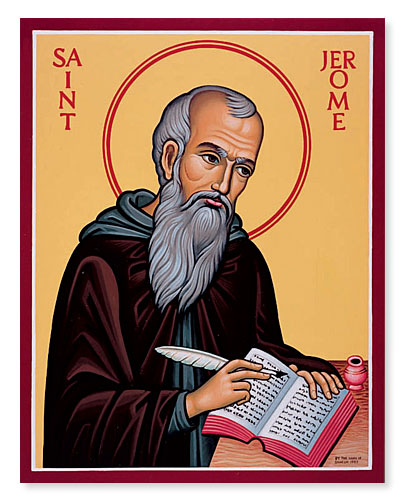
st-jeromeIn our ongoing discussion about how the Church perceives the Ark of the Covenant, we have explored the Old and New Testaments, apocryphal writings, and many of the Fathers. The trend up until now, with a few outliers, has been that the Church tends to see the Ark as a typological foreshadowing of the Holy Virgin Mary, the Mother of God. In this post we will examine how Saint Jerome applies this understanding. Unlike many of the Fathers we have already examined, Saint Jerome takes a practical approach by applying this teaching directly to the life of a nun with whom he is corresponding. This approach is sometimes called tropological and is distinguished by a stressing of moral metaphor.

Saint Jerome, writing in A.D. 384, composed a letter on the topic of virginity to a Roman lady named Eustochium, cofounder of a women’s monastery in Palestine.1 In this lengthy letter, Jerome describes both the proper motivations and way of life of those who choose the path of celibacy. He compares the ideal virgin with the Ark of the Covenant, likening a life of chastity to the nature of the Ark itself.

Like the ark of the covenant Christ’s spouse should be overlaid with gold within and without; she should be the guardian of the law of the Lord. Just as the ark contained nothing but the tables of the covenant, so in you there should be no thought of anything that is outside.2

Later, he sets forth the Holy Virgin Mary as the ultimate model of virginity, by extension drawing a connection between the Ark and the Holy Virgin.

Set before you the blessed Mary, whose surpassing purity made her meet to be the mother of the Lord. When the angel Gabriel came down to her, in the form of a man, and said: Hail, you that are highly favored; the Lord is with you, she was terror-stricken and unable to reply, for she had never been saluted by a man before. But, on learning who he was, she spoke, and one who had been afraid of a man conversed fearlessly with an angel. Now you, too, may be the Lord’s mother.3

Emphasizing Mary’s virginity by noting that she had never been hailed by a man, Saint Jerome’s tropological approach introduces a practical application of the typology to virginity. Up until now, we have seen applications of the typology that help us to understand the role of the Holy Virgin in the economy of salvation, and conversely to retrospectively understand what the Ark was. Jerome extends the metaphor of the Ark to every virgin who seeks to “put on Christ” (Galatians 3:27), and as such offers teaching about the celibate life. The Ark is a metaphor for the life of purity striven for by monastics and embodied by the Holy Virgin.

We will cram three more fathers’ thoughts on this topic into our next post in this series, wrapping up our tour of how the Fathers perceive the Ark. Our next step will be to explore how the Ark is treated in some of the great feasts of the Orthodox Church.


1 Louis Saltet, St. Jerome, in The Catholic Encyclopedia, vol. 8, (New York: Robert Appleton Company, 1910).

2 Saint Jerome, Letter 22: To Eustochium, trans. W.H. Fremantle, G. Lewis and W.G. Martley, in Nicene and Post-Nicene Fathers, Second Series, vol. 6, ed. by Philip Schaff and Henry Wace, (Buffalo, NY: Christian Literature Publishing Co., 1893), revised and edited for New Advent by Kevin Knight.

3 Ibid.