The Ark: Cyril, Fortunatus, and John

In this post we will wrap up our discussion of what the Fathers have to say about the Ark of the Covenant. I will reiterate here that the Church tends to see the Ark as a type of the Holy Virgin Mary.

Saint Cyril of Alexandria

icon_st-_cyril_of_alexandriaSaint Cyril, the twenty-fourth patriarch of Alexandria, lived from 376-444. Saint Cyril seems to hearken back to the tradition exemplified by Saint Irenaeus, but with some additions. The pattern of his statement very closely mirrors that of St. Irenaeus quoted previously, but he inserts some additional commentary that allows us to see the Ark as a type of the Theotokos. He seems to be trying to harmonize the common view of his day with a more ancient tradition.

The Ark would be the type and image of Christ: for if we look back to the way of the Incarnation of the Only-begotten, we shall see that it is in the temple of the Virgin, as in an ark that the Word of God took up His abode. For in Him dwelt all the fulness of the Godhead bodily, as the Scripture saith. But the testimonies in the ark were the word of God, and the wood of it was imperishable, and with pure and choicest gold was it beautified within and without. For the Body of Christ is incorruptible, being by the power and brightness of the indwelling Word, and the nature of life-giving operation of the Holy Ghost, maintained in incorruption [emphasis mine].1

Saint Venantius Fortunatus

Commemorated on December 14, the Latin poet and bishop lived circa A.D. 530-610. His usage of this typology supports a belief in the consistency of its application through later times. The following verse in Latin clearly identifies the Ark with the Holy Virgin.

Beata Mater, munere
Cujus supernus Artifex,
Mundum pugillo continens,
Ventris sub arca clausus est.2

While unpoetic, the following rendering is a relatively literal approximation of the above verse translated by myself.

The Holy Mother, by whose offering
The supreme artificer,
containing in His hand the World,
In the womb, within the Ark, was enclosed.

Saint John of Damascus

1204ajohndamascusSaint John, born in A.D. 676, wrote the famous Canon of Pascha that is sung during the Orthodox Pascha services. In the Canon, Saint John doesn’t seem to commit to a specific typological relationship for the Ark. His intention seems to be to expose the contrast between human experience of the types and human experience of the fulfillment.

God’s forebear David, dancing, leaped before the Ark, mere shadow, but seeing the fulfilment of the types, let us, God’s holy people, inspired, rejoice, for Christ has risen as omnipotent.3

In our next post in this series, we will examine how two of the great feasts of the Orthodox Church portray the Ark of the Covenant.


Qtd. in Thomas Livius, The Blessed Virgin in the Fathers of the First Six Centuries, (London: Burns and Oates, Limited 1893), pp. 76–77.

Ibid., p. 458.

Archimandrite Ephrem, Paschal Canon Noted, in Anastasis, p. 3.

Judith: Naming People and Places

E0702 RIEDEL WAF826

Judith, by August Reidel, 1840

I decided to revise the way I was translating names of people and geographical features in An Explanation of the Book of Judith. My initial approach was to use the names found in the Orthodox Study Bible (OSB), which tend to follow the standards set by the King James Version (KJV). The Vulgate and the Septuagint tend to have different ways of writing the names that also provide differences in pronunciation. The KJV tends to choose names that are closer to the Hebrew, I believe generally following the Masoretic Text. Because the KJV has had such a strong impact on our modern usage and expectations, it seems to make sense to use these names. However, because of the fact that I’m working on what I hope will be a relatively literal translation, and because I’m including translations of the Vulgate (the version of the Bible Abp. Rabanus used) from the Douay-Rheims (D-R) translation of the Vulgate directly in the text, I have decided to shift to using the names from the D-R throughout.

What this means is that some of the names may be somewhat unfamiliar to people who are accustomed to typical modern usage. For instance, in the D-R rather than Nebuchadnezzar, we find Nabuchodonosor. Or, rather than Ishmael, we find Ismahel. However, these names reflect how the Blessed Rabanus actually wrote the names in his commentary. In many cases, these are literally the same in English as they are in Latin.

What I have found is that, in many cases, choosing how to name something is actually more difficult than the rest of the translation work. For instance, some of the names don’t actually exist in the D-R or the Vulgate and I have to choose another source, such as Saint Jerome’s Chronicon (or the Latin version). I can use the name verbatim from the Latin, or I can look in alternative sources. Sometimes digging around online can turn up a more commonly spelled version of a name such as Arbis. In the Vulgate this name is Arbimin, but Arbimin is pretty hard to find when searching in Google. It turns out that the more common name is Arbis, which actually turns out to be the modern day Porali River in Pakistan.

During the course of this process of name revision, I have actually made some interesting discoveries. For instance, the D-R names a river Jadason, which the Beatus calls Hiadas. Then in a later spot, when quoting Orosius, it is called Idaspem. Idaspem is an unusual way to spell Hydaspem or Hydaspes. The OSB uses Hydaspes where the D-R uses Jadason, which brought me to the realization that they are the same. Other sources confirm this. Further research indicates that it is the modern day Jhelum river that flows through India and Pakistan.

In order to make this process manageable, I ended up creating tables of names in appendices. There is a table of people and a table of geographical names. The tables include the versions of the names found in this translation, the Douay-Rheims, the Orthodox Study Bible, Jerome’s Chronicon, and the Latin itself. Creating this table enables relatively easy future revisions using a simple search and replace feature.

For further information about this translation project, please see my series of posts on Judith.

Judith: Three Chapters Translated

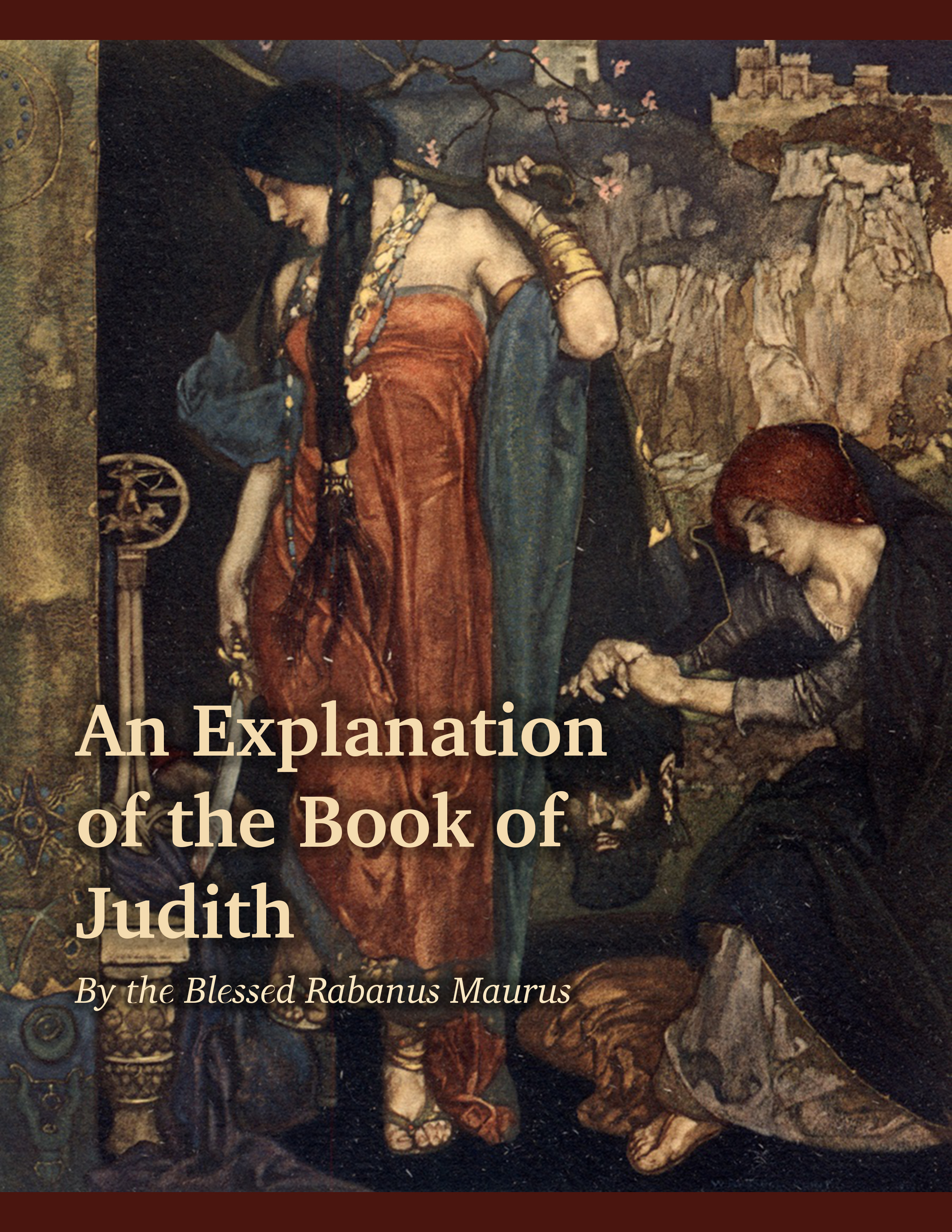
judith-cover-2In celebration of completing drafts of the first three chapters of my translation of the Blessed Rabanus Maurus’ commentary on Judith, I am making it available publicly. This is by no means the final version. There will likely be multiple revisions, but this should give a reasonably good representation of what the bishop said about the Book of Judith. Additionally, I have just received a copy of a modern critical edition of the text that I will use to go back through these chapters and make some revisions. This new edition denotes quotations from other sources and so will save me a lot of work in hunting those down.

When I began translating this commentary I had no idea what I was getting into. Given the present pace of translation, I expect it will take 3–5 years to complete. In addition to improving my Latin, this work is improving my understanding of history as well. I feel the need to understand the context in which the translator lived and so have taken this opportunity to study the early middle ages. In addition to hagiographic literature about Rabanus, I have begun delving into some more scholarly papers addressing the life of the Blessed Rabanus Maurus and his work. In particular, Exegesis for an Empress, by Mayke de Jong has been enlightening. But perhaps most engaging and broadly useful has been an online course on The Early Middle Ages. (I’ve been very pleased with my subscription to The Great Courses Plus).

In addition, I have included an idea for a cover above. There are many great works of art that portray scenes from the story, but I chose an illustration by a relatively recent artist named W. Russell Flint, who produced an illustrated edition of Chaucer’s Canterbury Tales. This image is from that book.

Note that I am using Google Documents to do my work. That means that online collaboration becomes very simple. In fact, if you follow the link to the document you will, even without being logged in to Google, be able to add comments and suggested edits to the work. If you wish to contribute feedback in either of these ways, you are invited to do so. It would be nice if you would log in so that I can see who has made the comments, but I’ll still accept anonymous feedback and corrections. Even if you don’t read Latin, grammar and spelling corrections are useful (though I’ll likely maintain Rabanus’ run-on sentences in the first revision and later work on breaking them up for modern readers).

The present version of the translation can be seen here:

An Explanation of the Book of Judith

For further information about this translation project, please see my series of posts on Judith.

Judith: Sources and Translations

In translating The Blessed Rabanus Maurus’ explanation of the Book of Judith, I have greatly benefitted from Google’s search capabilities. The simple fact of the matter is that without this oracular power, I would probably be incapable of doing such a thorough job of ascertaining Rabanus’ sources. At this time (I’m half way through chapter 3), I have found that Rabanus makes use of a number of sources (without much acknowledgement), including Orosius, Josephus, Eusebius, and Saint Jerome. Occasionally I will come across a phrase that I find exceedingly difficult to translate and will resort to Google to see if a similar phrase is used in another work and if a translation has already been made of said phrase. These are the times when I accidentally discover that Rabanus has quoted another author, often verbatim.

I am going to share one of these translations and another translation of it from a modern author. In this case, I had already translated the entire passage (which omits a few sentences from the middle) before I discovered Bosanquet’s translation. This is a passage from volume 2 of Paulus Orosius’ Historiae Adversus Paganos, or History Against the Pagans. Orosius was a student of Saint Augustine of Hippo. My translation follows (overlapping portions are boldface):

The first king among the Assyrians, who achieved preeminence among the rest, was Ninus. With the murder of Ninus, Semiramis his wife and queen of all Asia restored the city of Babylon and established that it would be the head of the Assyrian empire, and thus did the kingdom of the Assyrians long stand with unshaken power. But when Arbatus, whom others call Arbaces, the prefect of the Medes, and from the same race as Medus, had killed Sardanapalus his king in Babylon, he transferred the name and substance of the kingdom to the Medes: truly under these circumstances, in the year in which the kingdom of Babylon was diverted to the Medes, in this year did Procas the father of Amulius and Numitor, the uncle of Rhea Silvia who was the mother of Romulus, begin to reign among the Latins 

However, with the withdrawal of Arbatus to the Medes, the Chaldeans retained possession of part of the kingdom, for they claimed Babylon for themselves against the Medes. Thus the strength of Babylon, which had belonged to the Chaldeans, came among the Medes; The Chaldeans, however, because of the royal city’s ancient renown, which was no longer theirs, preferred to declare themselves to belong to it.

Whence it came to pass that Nebuchadnezzar and other kings after him until Cyrus, however potent in the powers of the Chaldeans and manifestly bequeathed with the name of Babylon, are not included in the number and order of the illustrious kings.

The following translation comes from Chronology of the Times of Daniel, Ezra, and Nehemiah, by James Whatman Bosanquet, Esq., published in 1848.

Thus the kingdom of Ninus and Babylon was conveyed to the Medes, in the same year that Procas, the father of Amulius and Numitor, the grandfather of Rhea Silvia, who was the mother of Romulus, began to reign over the Latins. But, as an evidence that all these things happened according to the ineffable mysteries and deep designs of God, and not by human power or uncertain chance, all ancient history begins with Ninus, all Roman history with Procas. Again, from the first year of the empire of Ninus, to the time when the foundation of Babylon was laid by Semiramis, is sixty-four years; and from the first year of Procas, when he began to reign, to the building of the city by Romulus, is exactly sixty four years. So that while Procas reigned, the seed of future Rome was sown, though the germ was not yet to shoot forth. In the same year of the same Procas the kingdom of Babylon failed, though Babylon itself remained. For Arbatus (Arbaces) having fallen upon the Medes, the Chaldaeans, who vindicated to themselves the possession of Babylon against the Medes, retained in their power a portion of the kingdom. Thus the power over the province of Babylonia was with the Medes, the possession with the Chaldaeans. The Chaldaeans, however, in consideration of the ancient dignity of the royal city, preferred to call themselves the subjects of Babylon, rather than that the city should be called after them. From whence it happened that Nebuchodonosor and his successors down to Cyrus, though counted powerful from the strength of the Chaldaeans, and distinguished by the name of Babylonia, were, nevertheless, not included in the number or succession of illustrious monarchs.

For those of you who are readers of Latin, you are invited to provide corrections of my translation from the original Latin. Note that my translations tend to be relatively literal, perhaps too literal at times.

Another thing to note about this commentary is that Rabanus goes to some fairly extensive efforts to try to place the story within the context of history and also geography, whereas most modern scholars believe that Judith is a fictional or allegorical parody rather than an actual historical account. Father Patrick Henry Reardon is one of those who argues against an historical account in his article, Apocryphal Judith, Saintly Deceiver.

For further information about this translation project, please see my series of posts on Judith.