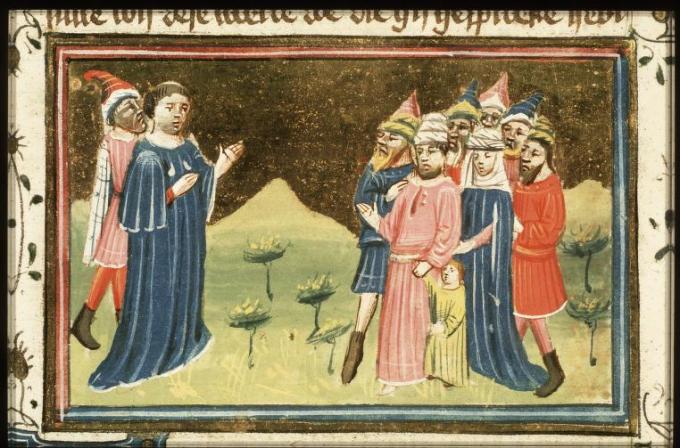
The Citizens Complain (c. 1430), Azor Masters
I have completed a draft translation of chapter 7 of the Blessed Rabanus Maurus’ Commentary on the Book of Judith.
In chapter 7, the city of Bethulia is besieged by Holofernes and his army. The people of Bethulia earnestly beseech the Lord in prayer, yet, their faith is not as strong as it should be. Holofernes and his people notice that Bethulia has a water supply coming into the city through an aqueduct, so they block up the aqueduct, cutting off the supply of water. This clearly makes the people a bit nervous or even afraid, which is evident to the enemy simply from they way they act. Even once the main supply of water is cut off, there are sparse springs near the city walls that people come out to to drink. The Book of Judith notes that they would come out “to refresh themselves a little rather than to drink their fill” (Judith 7:7). This is what tips off the enemy.
Eventually the people come whining to the leaders of the city about the lack of water, begging them to surrender to Holofernes so that they can quench their thirst. The chief leader of the city, Ozias, asks them for a grace period of five days so that the Lord will have a chance to respond to their prayers.
Rabanus ties items in the story very directly to the things of everyday life. For instance, he ties this period of five days to the five senses of the body and finally convenience.
Those five days can be understood as the five senses of the body, by means of which the present life is derived. For indeed, just as the inept teacher seeks a span of five days for a grace period, so does anyone who unwisely promises that physical comfort is to be given from the Lord first-hand to his students, as if the generosity of the highest giver is in his power (given that time and a measure of concession consists more in the ability to give than to receive).
If, however, convenience is refused to be bestowed upon those things of the present life by the Supernal Judge, in accordance with their promise, they immediately desert them to turn aside into illicit desire, and by yielding to their persecutors they avoid physical pain; our Judith, that is the Holy Church, refuses and disdains as hurtful the condition of their agreement, which will be clearly demonstrated in the things that follow.
Rabanus likens the whinings of the citizens of Bethulia to our own lack of fortitude. While they are unable to wait upon the Lord on his own time, we too are unwilling to live with a little inconvenience in our lives. We yield to the temptation of the evil one in order to avoid pain. As we shall see in the next chapter, Judith, that is the Church, refuses this approach.
For further information about this translation project, please see my series of posts on Judith.

 Saint Maximus, in his
 Having wrapped up my diatribe on the
 Given my general focus on typology on this blog, I thought it apropos to say something about the typology evident in the Orthodox feast of Holy Theophany (our parish’s patronal feast), or Christ’s baptism. Today our family made the trek with many others from
 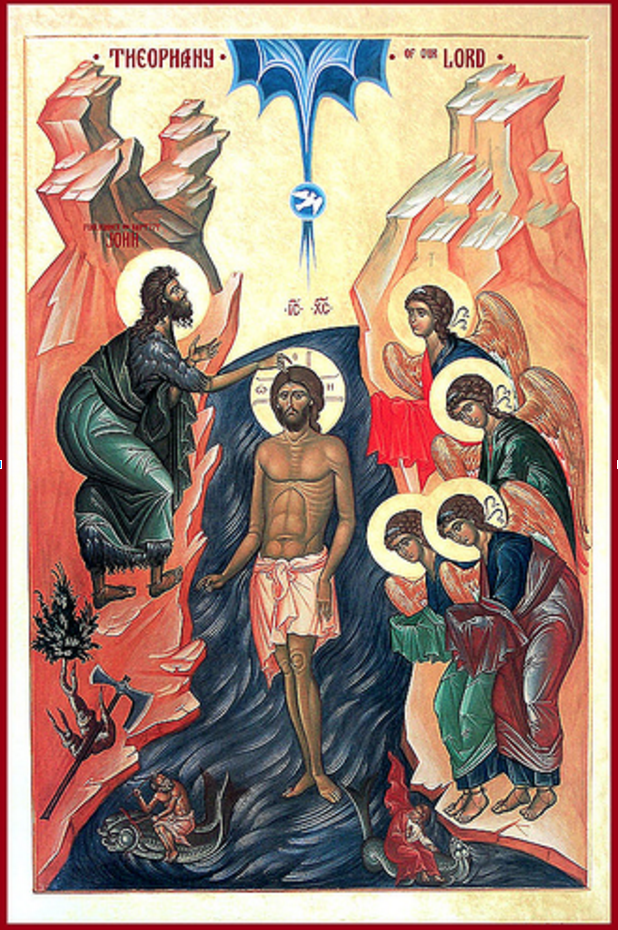 During these evening services, the reality of Theophany is explicitly connected with the events described in these ancient Scriptures by the Apostle Paul: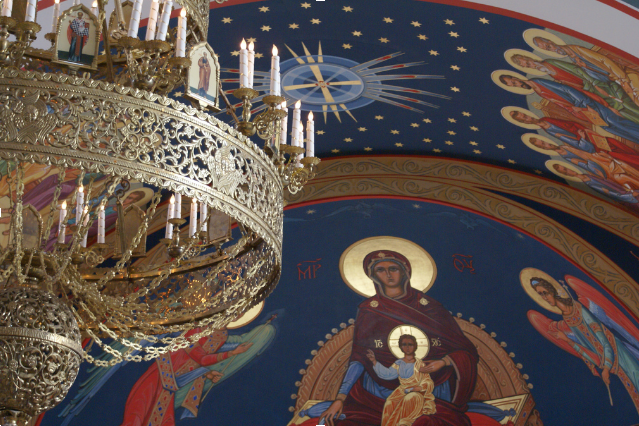

 Iconography depicting the Ark almost universally incorporates an emblem of the Theotokos upon the Ark itself. In the 16th century icon of the exaltation of the Ark by Master Theophane of Crete above, you see a circular emblem depicting the Theotokos both on the end of the Ark and at the end of the table upon which the Ark rests. You can see a closeup of the emblem on the Ark at right.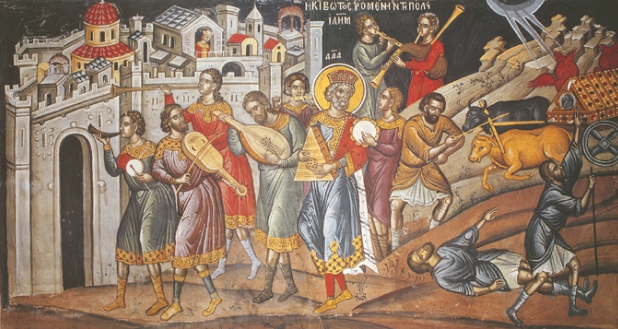


 The photo on the right from the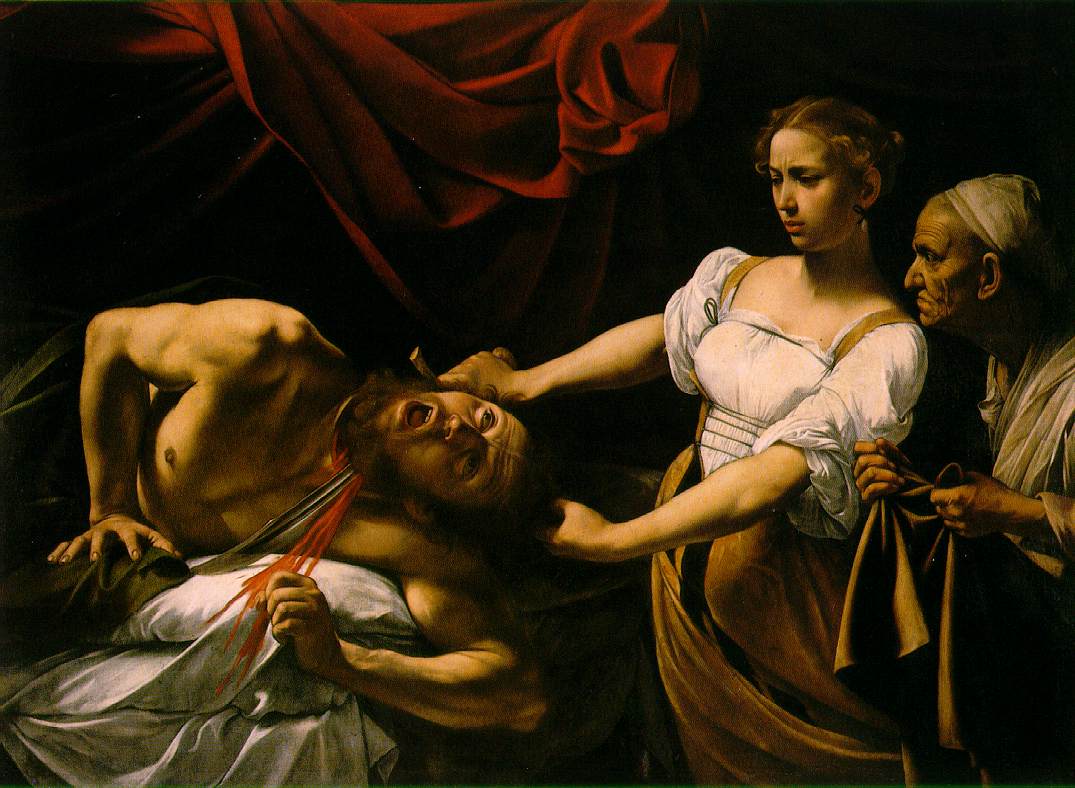
 parochianus