In our ongoing discussion of how the Church views the Ark of the Covenant, we have examined the Scriptures, apocryphal literature, and the writings of the Holy Fathers. In this post we begin to examine how this rich heritage directly impacts an Orthodox Christian in the ongoing life of the Church, starting with the annual cycle of services.
Entrance of the Theotokos
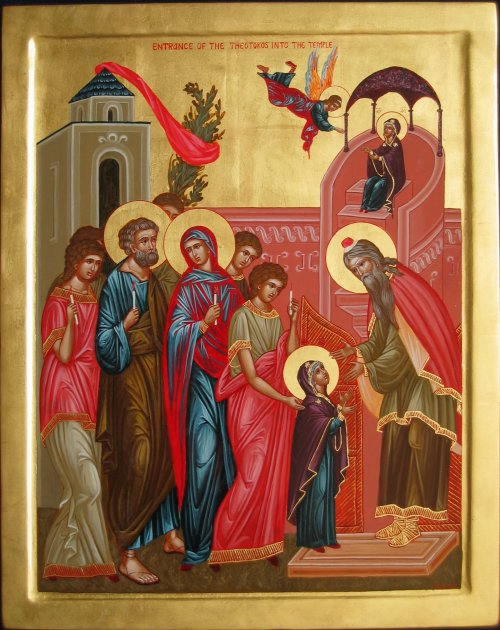 The feast of the entrance recalls our previous short review of the Infancy Gospel of James. This feast celebrates the events recorded in this gospel and recognizes a connection between Old Testament temple worship and the Holy Mother of God. However, it does not directly connect the Ark with the Theotokos. This feast seems to foreshadow the climactic events depicted during the Feast of the Dormition, which explicitly relates the Ark to the Theotokos. The kontakion below connects the Theotokos to the Tabernacle generally rather than to the Ark specifically.
The all-pure Temple of the Saviour, the precious Bridal Chamber and Virgin, the sacred Treasury of the glory of God, is being brought today into the house of the Lord; and with her she brings the grace of the divine Spirit; of her God’s Angels sing in praise: She is indeed the heavenly Tabernacle.1
Dormition of the Theotokos
 The Dormition of the Theotokos is perhaps the most explicit of the feasts of the Church when articulating the typology of the Ark of the Covenant. In one set of troparia, the story of the Dormition as related by The Falling Asleep of the Holy Mother of God, including the cutting off of the hands of Jephonias, is directly referenced and so affirmed. In these troparia, the Mother of God is explicitly called “the living Ark.”
Knowing you, All-blameless, to be a mortal woman, but beyond nature Mother of God, with fearful hands the illustrious Apostles touched you, as you blazed with glory, gazing on you as the Tabernacle that had received God.
Just punishment intervened to cut off the sacrilegious hands of the presumptuous, for God guarded with the glory of the godhead the reverence due to the living Ark, in which the Word had become flesh.2
The Virgin Mary is referred to as the Ark of Sanctification or Holiness at least four times and likened to the Ark in different ways several other times. In addition, the Theotokos is also identified with several other emblems of temple worship. In the above quote we see that she is likened to the Tabernacle and in the later troparia below, she is related to the pillar of cloud (Exodus 13:21), the table of the bread of life (Exodus 25:30), the lampstand (Exodus 25:31-40), the censer, Aaron’s rod, and the tablets of stone (Hebrews 9:4).
The Suzerain and God of all apportions to you the things above nature; for just as he kept you a Virgin in your giving birth, so he preserved your body incorrupt in the tomb, and he glorified you with him by a divine Translation, gracing you with honours, as a Son his Mother.
Your Offspring, O Virgin, has truly made you dwell in the Holy of Holies as shining Lampstand of the immaterial fire, golden Censer of the divine coal, Jar and Rod and Tablet written by God, holy Ark and Table of the bread of life.3
This latter set of troparia clearly draw your mind from the falling asleep of the Mother of God to her translation into the presence of the Most High God in the Most Holy Place in heaven, where aspects of her role there are typologically represented by each of these ancient artifacts of worship, not the least of which is the Ark. The entrance of the Theotokos into the earthly Temple is clearly a foreshadowing of her entrance into the heavenly Temple.
Other Hymns and Services
The Ark is frequently connected typologically to the Theotokos in various theotokia, as in the following example from Saturday evening Vespers (tone 1).
When Gabriel addressed you, O Virgin, with his ‘Hail’, as he spoke the Master of all things became incarnate in you the holy Ark, as righteous David sang. You were proclaimed wider than the heavens, for you carried your Creator. Glory to him who dwelt in you, glory to him who came forth from you, glory to him who has set us free through your bearing child.4
Theotokia of a similar nature are found often in the regular cycle of services, including Vespers and Matins. We find additional examples in other services such as the Akathist. The following excerpt from the Akathist emphasizes the Temple typology we found above in the feast of the Dormition.
Hail, tabernacle of God the Word
Hail, greater Holy of Holies.
Hail, Ark — gilded by the Spirit,
Hail, inexhaustible — treasure of life.5
Quite frequently in the services of the Church, the Ark is typologically connected to the Theotokos. What is important to note is that, while it is not consistently the central theme of these services, Orthodox Christians are nonetheless very frequently exposed to this typology. It is part of the warp and woof of Orthodox life.
In our next post in this series, we will examine how the iconography of the Church treats the Ark of the Covenant.
1 Archimandrite Ephrem, The Month of November, in Anastasis.
2 Archimandrite Ephrem, The Fifteenth of August, in Anastasis.
3 Ibid.
4 Archimandrite Ephrem, Paraklitiki Period of Tone 1 On Saturday Evening at Small Vespers, in Anastasis.
5 Archimandrite Ephrem, The Akathist, in Anastasis.
 Saint Cyril, the twenty-fourth patriarch of Alexandria, lived from 376-444. Saint Cyril seems to hearken back to the tradition exemplified by Saint Irenaeus, but with some additions. The pattern of his statement very closely mirrors
  Saint John, born in A.D. 676, wrote the famous Canon of Pascha that is sung during the Orthodox Pascha services. In the Canon, Saint John doesn’t seem to commit to a specific typological relationship for the Ark. His intention seems to be to expose the contrast between human experience of the types and human experience of the fulfillment.
 parochianus