The Ark: The Dormition of the Mother of God

In the previous post in our ongoing discussion of the Ark of the Covenant, we discussed the Infancy Gospel of James. In this post we will take a look at another work that the Church values and which is represented in the life of the Church through the Feast of the Dormition, which we will discuss in a later post. As we have discussed, the Church most frequently sees the Ark as a type of the Holy Virgin.Screen Shot 2016-08-24 at 2.02.57 PM
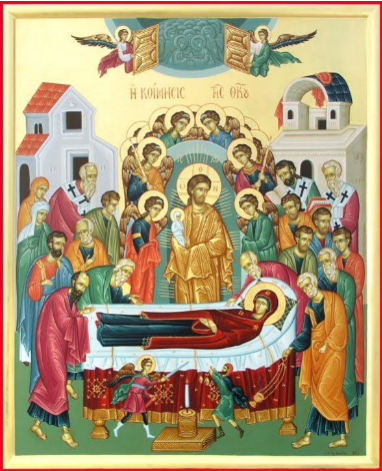
The Account of St. John the Theologian of the Falling Asleep of the Holy Mother of God is an apocryphal account of the dormition from a collection of writings known as the Transitus Mariae. Some scholars believe this collection to have been written in the late fourth or early fifth century,1 other sources place it in the second or third century.2 As with the Infancy Gospel of James, its apocryphal status does not mean that it is not a document of significant value. If nothing else, it is a good indicator of traditions in existence at the supposed time of its composition, as early as the second century. Incorporation of events it describes into the iconography affirms the value of its content.

The account tells of how the Apostles were brought together with the Mother of God at the time of her death and how her Son came to personally escort her soul into the heavens. After her soul had departed, the Apostles took up her body on a couch and carried it.

And, behold, while they were carrying her, a certain well-born Hebrew, Jephonias by name, running against the body, put his hands upon the couch; and, behold, an angel of the Lord by invisible power, with a sword of fire, cut off his two hands from his shoulders, and made them hang about the couch, lifted up in the air.3

This story has been compared to that of Uzzah. As mentioned above, when Uzzah reached out and touched the Ark, he was instantly killed. Another parallel exists between Jephonias and the idol of Dagon where the Ark was kept by the Philistines. During the second night of the Ark’s presence in Dagon’s temple, the idol of Dagon fell down and its hands were broken off (1 Samuel 5:4). It is notable that this event ended in a happy way, for, “at the word of Peter, the hands hanging by the couch of the Lady came, and were fixed on Jephonias. And he believed, and glorified Christ, God who had been born of her.”4

If you look closely at the icon, you can see Jephonias under the Holy Virgin with his hands floating about in the air, cut off by the sword the angel on the left is holding. The small white child being held by Christ is the Holy Virgin herself born again into the new life in Christ.

As with the Infancy Gospel of James, this gospel is not explicit about the typology of the Ark, but it is compatible with the hypothetical existence of such a tradition in the second century.

In our next post, we will begin a more lengthy series of twelve posts about the patristic witness to the Church’s understanding of the Ark of the Covenant. We will be examining what twelve of the Holy Fathers have to say about the Ark.


1 George Reid, Apocrypha, The Catholic Encyclopedia, Vol. 1, (New York: Robert Appleton Company, 1907).

Pope John Paul II, General Audience; Wednesday, 2 July 1997.

Translated by Alexander Walker, The Account of St. John the Theologian of the Falling Asleep of the Holy Mother of God, From Ante-Nicene Fathers, Vol. 8, Ed. Alexander Roberts, James Donaldson, A. Cleveland Coxe (Buffalo, NY: Christian Literature Publishing Co., 1886), Revised and edited for New Advent by Kevin Knight.

Ibid.

The Ark: Infancy Gospel of James

In our previous post, we diverged into a discussion of what typology is and why it matters. Here we return to the topic at hand, the Ark of the Covenant. Both this and the next post in this series will consider works that are sometimes called “apocrypha.” The Orthodox Church does not attach the same stigma to apocryphal works that many protestant traditions have, and while not part of the canon of scripture, many are still considered worthy of study.

The Infancy Gospel of James (this link to the work itself is a quick and interesting read), sometimes called the Protoevangelion of James, is an apocryphal gospel, likely from the second century, that was never accorded canonical status;1 which is not to say that it isn’t a document that has been valued in the Orthodox Church up until the present. This gospel demonstrates that the events celebrated by the Feast of the Entrance of the Theotokos were present in a very early tradition. We will discuss this feast, which continues to be celebrated annually by both the Catholic Church and the Orthodox Church, in a later post.

This gospel tells the story of the infancy and childhood of Mary the Mother of God. Of importance to the topic at hand are some allusions to her entrance into the Holy of Holies in the temple. The gospel tells how, at the age of three, her parents, Joachim and Anna, took her to the temple to be dedicated as a virgin to the service of God just as Hannah took the Prophet Samuel to the temple. The high priest received her, recognizing that the Lord would reveal His redemption through her. He placed her on the third step of the altar where she “danced with her feet.” In the gospel Mary is said to have been, “nurtured in the Holy of Holies, and received food from the hand of an angel.”2

(Some might wonder about having a girl in the temple, but the Scriptures themselves tell of the prophetess Anna, who “did not depart from the temple, but served God with fastings and prayers night and day” Luke 2:37 OSB).

What is striking is that, as we saw earlier, the Ark of the Covenant was no longer in the temple at this time, so the Holy of Holies was essentially empty when Mary entered it. Given this sequence of events, it would be unremarkable if readers of this gospel were to infer that the Holy Virgin had come at the appropriate time to replace the Ark of the Covenant as the dwelling place of God. While this gospel is certainly not explicit about such typology, it is compatible with the hypothetical existence of such a tradition in the second century, just as we found previously that there was enough potential allusion in the New Testament to allow for the theoretical existence of such an early tradition.

In the next post we will discuss the Account of St. John the Theologian of the Falling Asleep of the Holy Mother of God. If you’re interested in delving deeper into the Infancy Gospel, you can certainly follow the link above, but Frederica Matthewes-Greene has published a rather nice edition with her own commentary entitled, The Lost Gospel of Mary.


1 George Reid, Apocrypha, The Catholic Encyclopedia, Vol. 1, (New York: Robert Appleton Company, 1907).

2 Frederica Matthewes-Greene, The Lost Gospel of Mary, (Brewster, MA: Paraclete Press, 2007), P. 55.

Ark of the Covenant in the New Testament

In part 2 of this series, we talked about the Ark of the Covenant in the Old Testament. Here we stroll into more ambiguous territory and attempt to find connections in places where they are not explicit. We focus on typological reference to the Ark. This part of the study is based on modern scholarship rather than on Biblical or Patristic sources. It’s far from certain, but still worthy of discussion. As mentioned at the beginning of this series, the Ark is often connected typologically to the virgin Mary, who is sometimes called the Ark of the New Covenant.

While the typology of the Ark is not directly mentioned in the Holy Scriptures, there exist several possible allusions that are worth discussing. A midrashic approach, exemplified by Fr. René Laurentin, attempts to find an intentional anamnesis embedded in Luke’s infancy narrative, intended to connect it with the Old Testament theme of God being present in the bosom of his people. First emerging in Exodus 33:3 and 34:9, it is developed throughout the Old Testament narrative, which progressively establishes the Ark as the epicenter of God’s presence in Israel.1

Fr. René finds numerous interesting textual parallels between Luke’s language and Ark-related imagery in the Old Testament. For instance, when God takes up residence in Israel, his glory overshadows the tabernacle (Exodus 40:35) just as the power of God overshadows the Holy Virgin as described by Gabriel during the Annunciation (Luke 1:35). In another case he compares David’s transfer of the Ark to Jerusalem (2 Samuel 6:2-11) with Jesus’ journey to Jerusalem in the womb of his mother (Luke 1:33-44).2

Fr. René surmises that Luke identified the events portrayed in his infancy narrative with the eschatological fulfillment of this theme as proclaimed by the Prophet Zephaniah. In this prophecy, the Daughter of Zion is thought to be the Holy Virgin and it is here that the typology of both the Ark and the Daughter of Zion converge, as we see God present in the bosom of His people:3

Rejoice greatly, O daughter of Zion! Cry aloud, O daughter of Jerusalem! Be glad and rejoice with your whole heart, O daughter of Jerusalem! The Lord thy God in the midst of thee is mighty; he will save, he will rejoice over thee with joy; he will rest in his love, he will joy over thee with singing (Zephaniah 3:14, 17).

A less ambiguous example is the Visitation narrative found in Luke 1:39-44. Elizabeth exclaims, “But why is this granted to me, that the mother of my Lord should come to me” (Luke 1:43)? This parallels David’s question, “In what possible way can the ark of the Lord come with me” (2 Samuel 6:9)? Similarly, Mary remains in the house of Elizabeth for three months just as the Ark remained in the house of Obededom for three months.4

Many in the Roman Catholic church find a connection between the Ark described at the end of chapter eleven of Revelation and the woman described in the beginning of chapter twelve. Chapter divisions were not present at the time of writing, so the two figures would have been seen tightly juxtaposed by earlier readers. Most of the Holy Fathers see this woman as a figure of the Church, but Cardinal John Henry Newman does not believe this precludes the woman from representing the Theotokos. He explains,

Now I do not deny of course that under the image of the Woman, the Church is signified; but what I would maintain is this, that the Holy Apostle would not have spoken of the Church under this particular image unless there had existed a Blessed Virgin Mary who was exalted on high and the object of veneration of all the faithful.5

In part 4, we’ll take a brief interlude from the topic at hand and discuss typology and why it matters.


François Bovon, Luke the Theologian: Fifty-five Years of Research (1950-2005), (Waco, TX: Baylor University Press, 2005), p. 182-185.

Ibid.

Ibid.

Michael O’Carroll, Theotokos: A Theological Encyclopedia of the Blessed Virgin Mary, <Eugene, OR: Wipf and Stock Publishers 2000>, p. 50.

Cardinal John Henry Newman, Modern History Sourcebook: John Henry Newman On the Blessed Virgin Mary, <15 March 2016>.

Ark of the Covenant – Intro

The first topic I’d like to discuss is the meaning behind the Ark of the Covenant. I’ve spent a fair amount of time studying how the Church views the Ark and thus I expect this will be a rather lengthy series of posts.

Few emblems in salvation history evoke the level of mystique borne by the Ark of the Covenant. The Ark is the “Holy Grail” of the Old Testament in a manner of speaking. While the Ark contained great power and served as the throne of God on earth in its day, it, as many of the other ancient emblems prior to the incarnation, served a typological role referencing its antitype further into the future. The Ark is most frequently related by the Church to the most holy Theotokos and ever virgin Mary, who is sometimes called the Ark of the New Covenant. It is this typological relationship that the present series explores.

It is clear from a review of the Scriptures, patristic literature, so-called apocryphal accounts, hymnology, festal celebrations, iconography, and other forms of tradition, that the Church’s expression of this typal relationship develops over the centuries. This series examines, as chronologically as possible, evidence from the life of the Church demonstrating the ways in which this typology is expressed, discussed, and understood and how the expression of the typology develops as the Church deepens its understanding.

In my next post, I’ll discuss how the Ark was viewed in Old Testament terms.