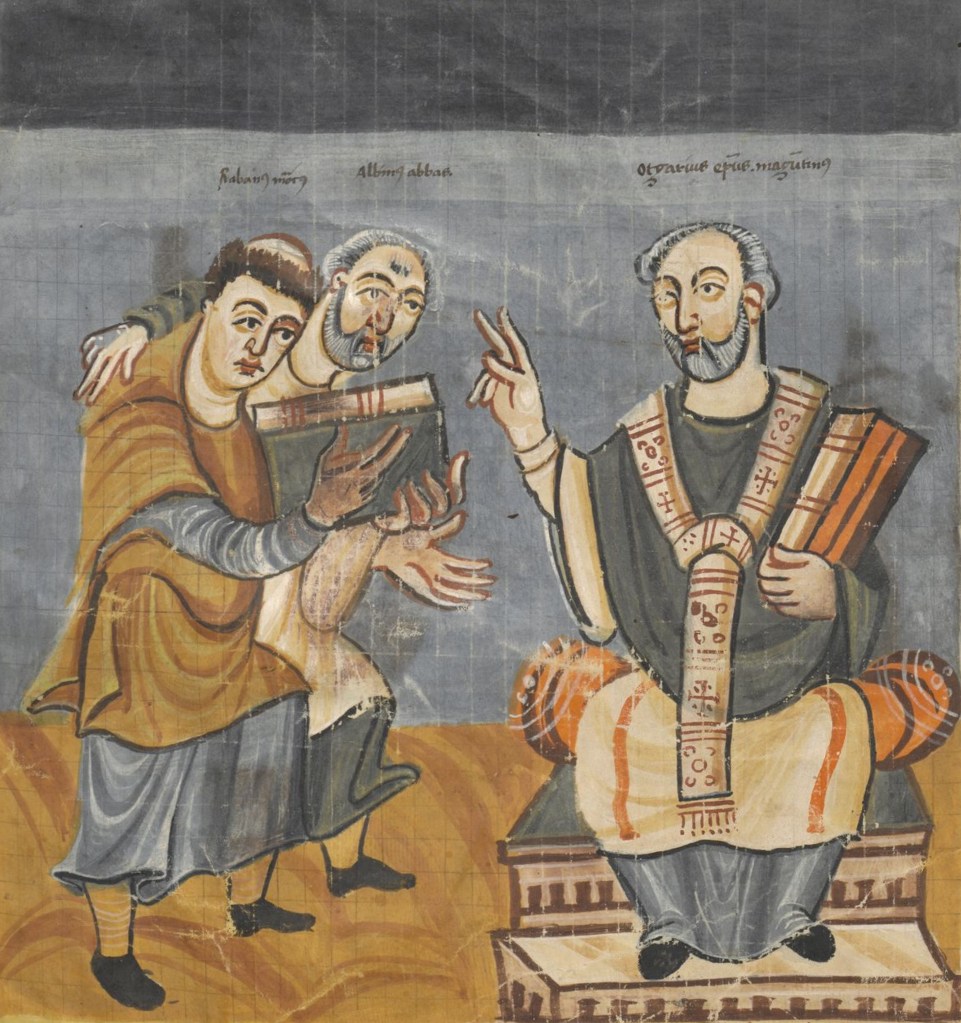
Paschal Homily of Rabanus Maurus

Note: I don’t know if this is a homily written by the Blessed Rabanus Maurus himself, or just one he added to his collection of homilies, but it seemed very appropriate to translate it and make it available as we quickly approach Pascha.

Our Pascha, dearly beloved, is the resurrection of Christ, for Pascha means a passing over, clearly from death to life, from passion to glory, from Hades to Paradise. For, in that Christ died, our death was destroyed; in that He arose, He granted us the means of arising and made us cross over from infidelity to the Catholic Faith, from idolatry to the worship of the One God, from sin to righteousness, from error to truth, from discord to peace, from useless servants sold into slavery to the devil to being counted among the children of God, from exile to the homeland, from punishment to a crown.

And therefore, dearly beloved, the Pascha of Christ is the Kingdom of Heaven, the salvation of the world, the death of Hades, the glory of Heaven, the life of believers, the resurrection of the dead, the evidence of divine compassion, the price of human redemption, and the abolition of death’s sorrow. This feast, by a holy mystery of God, through the angels reveals, through the people manifests, and through the good hearts of believers multiplies the power of the Lord’s resurrection. So this is that day that the Psalmist once foretold, saying, “This is the day which the Lord hath made: let us be glad and rejoice therein” (Ps 117:24); higher than everything, brighter than all things, on which the Lord arose; on which, as you can see, He acquired a new people for himself through the spirit of regeneration; on which He imbued the minds of each one with joy and exultation. Therefore, this day of the resurrection of Christ is life for the dead, pardon for sinners, and glory for the saints.

How, then, does the Virgin Mary, the Mother of the Lord, retain first place among all women, and likewise this feast day is the chief among all days on earth? Just as we read the “Holy of Holies” or the “Song of Songs” in the Scriptures, we rightly call this the solemnity of solemnities.

Only Christ with the thief opened that fiery spear and door of paradise that no one could break open (Gen 3:24). The gate of paradise, which no one before the Passion of the Lord uncovered, has been both closed and open from the time when the Lord suffered until the present day; it is closed to sinners and unbelievers; it is open for the righteous and believers. Through it, the Apostle Peter entered; through it, the Apostle Paul entered; through it, all the holy martyrs entered; through it, the souls of the righteous from the whole world daily enter.

However, there are two gates: the gate of Paradise and the gate of the Church. We entered through the gate of the Church first, through faith and baptism, because we will certainly enter the gate of paradise after our exit from life if we faithfully continue laboring well. Without a doubt, the Holy Church is the house of God, and so we ought to live in such a way that we are not cast out of that house; cast forth and devoured by wild beasts, which are evil spirits. The prophet says of this, “Deliver not up to beasts,” oh Lord, “the souls that confess to thee” (Ps 73:19). Therefore, let us constantly dwell in her who is our mother the Church so that we may deserve to reach the kingdom of the eternal Father; the Father for whom she gave birth to us who are children by adoption.

Let us celebrate this holiest of solemnities as the Apostle Paul taught us, saying, “not with the old leaven, nor with the leaven of malice and wickedness” (1 Cor 5:8), in other words, not in the bitterness of human malice, but in the sincerity of divine holiness, which is chastity, humility, goodness, compassion, kindness, righteousness, gentleness, patience, truth, peace, and generosity. This is the dough of Christian sanctity, which is corrupted by the leaven of human wickedness, which is lust, arrogance, envy, unfairness, greed, intemperance, lying, bickering, hatred, vainglory, cruelty, and injustice. It causes all alien kinds of corruption for us, and yet the sincerity of His truth in us is kept safe by Him, the author and bestower of all good things and the originator of this holiest of feasts, Jesus Christ, our Savior, who lives and reigns with God the Father in the unity of the Holy Spirit, God throughout all the ages of ages.

Amen.
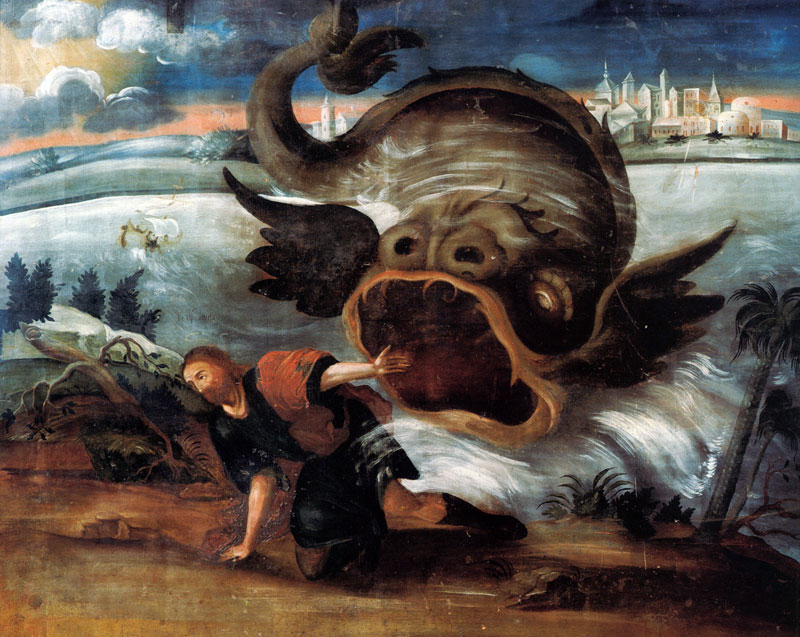
Descent into Hell

For as Jonah was three days and three nights in the belly of the great fish, so will the Son of Man be three days and three nights in the heart of the earth (Matthew 12:40 OSB).

2013_11_15_00_03Jonah’s flight from God brings him to a point in time when he must make a decision. He can choose between continuing to hide, or offering himself to save the seafarers onboard the ship. Just as Christ sought to “let this cup pass from me,” Jonah sought another path. But in the end, he saw that for the sake of others, he had to pass through suffering and, from his perspective, probably death.

Jonah, while reluctant, follows the pattern of Christ’s life. The Christian too, while reluctant, must follow this path. When initially given a command to obey, we disobey and hide from God. All of mankind has sinned and hidden from God as did both Jonah and Adam, but Christ, as the culmination of God’s winnowing action upon mankind, like the fine point of a needle, opens the way of salvation. Jonah’s descent into the depths of the sea for three days typifies Christ’s descent into hell and our descent in his wake through the baptism of water and of tears.

I recently experienced the joy of a friend’s wedding. Father Anthony, the presiding priest, observed in his homily that the act of martyrdom is present in each of the sacraments. Baptism demonstrates the death of self and the renewal into life brought by this sacrifice. Confession too contains the death and suffering of the self. The sacrament of marriage is replete with martyrdom and self-sacrifice for the sake of one’s spouse. And of course the ultimate sacrifice is evident in Christ’s self-offering of the Eucharist.

The prerequisite for redemption is sacrifice. Out of the depths of Christ’s sacrifice, he raises up his apostles unto the Gentiles just as Jonah ascended from the depths to the Ninevites. We must likewise, through our own self-sacrifice, ‘tradition’ the faith to our spiritual descendants. Saint Paul presents himself as a metaphor of Christ, revealing that he carries about in his own body the death of the Lord Jesus, that His life might be made manifest in his children (2 Corinthians 7-12). Like the risen Lord, Paul metaphorically dies so that his children might live. It is this continual cycle of death and rebirth that is the essence of tradition.

Ultimately, Christ’s resurrection and ascension culminate in our deification. Saint Athanasius the Great said that, “The Son of God became man that we might become god.” Christ, in his descent into death and ascent into life, ‘traditions’ unto us the purifying power of martyrdom and the sanctifying power of the Holy Spirit in the outpouring of Pentecost. The purification experienced through martyrdom prepares us for the sanctifying power of the Holy Spirit.

Material persons are purified, sanctified, and deified. Bread and wine become God. Bones work miracles. The dead live.

The martyrs are those who have truly sacrificed everything for God. They are seeds who have been planted, died, and risen into true life. They have finally become human.

Most assuredly, I say to you, unless a grain of wheat falls into the ground and dies, it remains alone; but if it dies, it produces much grain. He who loves his life will lose it, and he who hates his life in this world will keep it for eternal life (John 12:24-25).

Purity of Heart

Because I have been practicing with the choir in preparation for Pascha, I had an opportunity to sing the hymn we sing at midnight:

Thy resurrection oh Christ our savior,
the angels in heaven sing,
enables us on earth
to glorify thee in purity of heart.

For some reason singing that caused me to think about the implications of what it says. It seems obvious and maybe intuitive, but I ended up spending several hours pouring through theology books in an attempt to find a good articulation of the reality.

I ended up with two passages from different theology books that, while perhaps not explicit about purity of heart, lead one on the path to understanding. The first passage relates in detail what happened at the death and resurrection of our Lord. This is taken from Orthodox Dogmatic Theology by Protopresbyter Michael Pomazansky:

Christ, after His death on the Cross, descended in His soul and in His Divinity into hell, at the same time that His body remained in the grave. He preached salvation to the captives of hell and brought up from there all the Old Testament righteous ones into the bright mansions of the Kingdom of Heaven. Concerning this raising up of the righteous ones from hell, we read in the Epistle of St. Peter: “For Christ also hath once suffered for sins, the just for the unjust, that He might bring us to God, being put to death in the flesh, but quickened by the Spirit; by which also He went and preached unto the spirits in prison” (1 Peter 3:18-19). And in the same place we read further: “For this cause was the Gospel preached also to them that are dead, that they might be judged according to men in the flesh, but live according to God in the spirit” (1 Peter 4:6). St. Paul speaks of the same thing: quoting the verse of the Psalm, “When He ascended up on high, He led captivity captive, and gave gifts unto men,” the Apostle continues: “Now that He ascended, what is it but that He also descended first into the lower parts of the earth? He that descended is the same also that ascended up far above all the heavens, that He might fill all things” (Eph. 4:8-10).

To use the words of St. John Chrysostom, “Hell was taken captive by the Lord Who descended into it. It was laid waste, it was mocked, it was put to death, it was overthrown, it was bound” (Homily on Pascha).

I suppose one might wonder how one could have any purity of heart if one was held captive in hell. That’s somewhat crude, but it’s clear that death and hell are a factor that would prevent us from glorifying Christ in purity of heart.

The second passage I found helpful is from The Mystical Theology of the Eastern Church by Vladimir Lossky:

The way of deification, which was planned for the first man, will be impossible until human nature triumphs over sin and death. The way to union will henceforth be presented to fallen humanity as salvation. This negative term stands for the removal of an obstacle: one is saved from something—from death, and from sin—its root. The divine plan was not fulfilled by Adam; instead of the straight line of ascent towards God, the will of the first man followed a path contrary to nature, and ending in death. God alone can endow men with the possibility of deification, by liberating him at one and the same time from death and from captivity to sin. What man ought to have attained by raising himself up to God, God achieved by descending to man. That is why the triple barrier which separates us from God—death, sin, nature—impassable for men, is broken through by God in the inverse order, beginning with the union of the separated natures, and ending with victory over death. Nicholas Cabasilas, a Byzantine theologian of the fourteenth century, said on this subject: “The Lord allowed men, separated from God by the triple barrier of nature, sin and death, to be fully possessed of Him and to be directly united to Him by the fact he has set aside each barrier in turn: that of nature by His incarnation, of sin by His death, and of death by His resurrection.” This is the reason why St. Paul writes: “The last enemy that shall be destroyed is death” (I Cor 15:26).

This makes it clear that the last barrier is death and thus the resurrection is that event which finally unravels or removes the the last barrier to deification, and thus purity of heart.