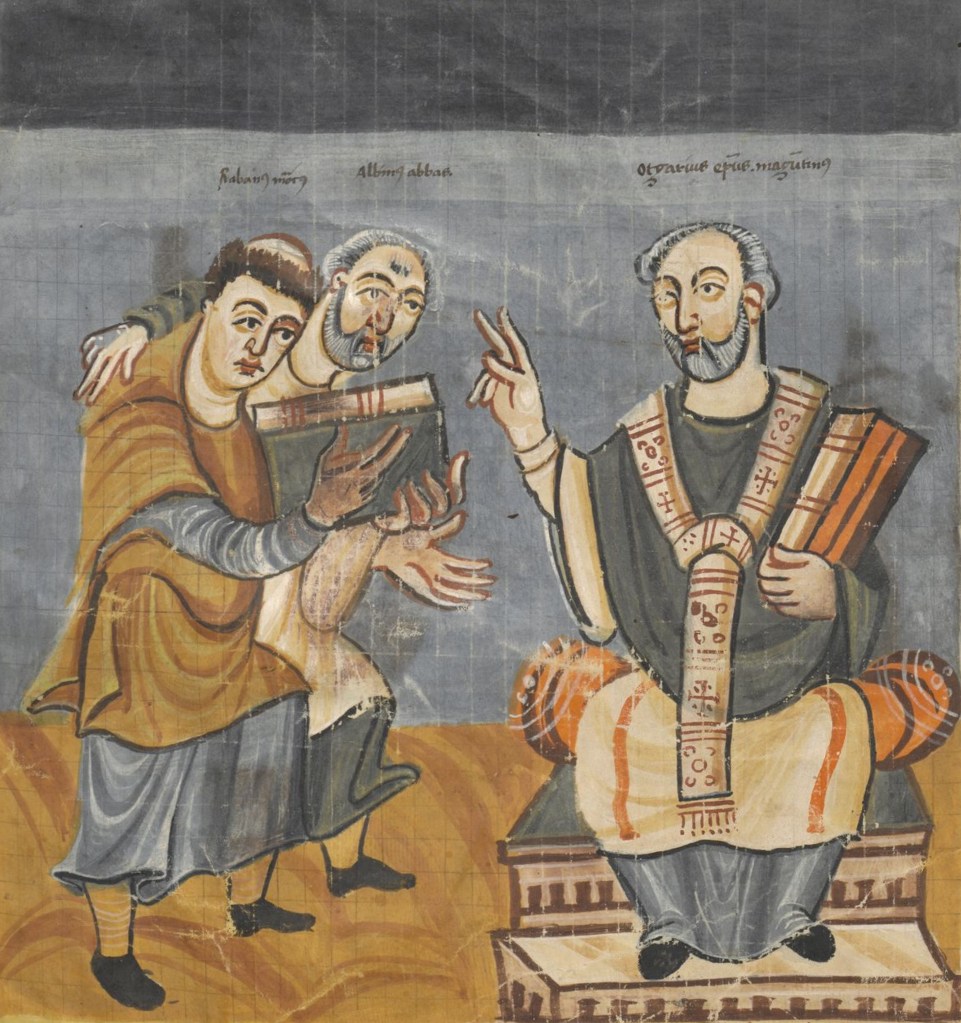
Note: I don’t know if this is a homily written by the Blessed Rabanus Maurus himself, or just one he added to his collection of homilies, but it seemed very appropriate to translate it and make it available as we quickly approach Pascha.
Our Pascha, dearly beloved, is the resurrection of Christ, for Pascha means a passing over, clearly from death to life, from passion to glory, from Hades to Paradise. For, in that Christ died, our death was destroyed; in that He arose, He granted us the means of arising and made us cross over from infidelity to the Catholic Faith, from idolatry to the worship of the One God, from sin to righteousness, from error to truth, from discord to peace, from useless servants sold into slavery to the devil to being counted among the children of God, from exile to the homeland, from punishment to a crown.
And therefore, dearly beloved, the Pascha of Christ is the Kingdom of Heaven, the salvation of the world, the death of Hades, the glory of Heaven, the life of believers, the resurrection of the dead, the evidence of divine compassion, the price of human redemption, and the abolition of death’s sorrow. This feast, by a holy mystery of God, through the angels reveals, through the people manifests, and through the good hearts of believers multiplies the power of the Lord’s resurrection. So this is that day that the Psalmist once foretold, saying, “This is the day which the Lord hath made: let us be glad and rejoice therein” (Ps 117:24); higher than everything, brighter than all things, on which the Lord arose; on which, as you can see, He acquired a new people for himself through the spirit of regeneration; on which He imbued the minds of each one with joy and exultation. Therefore, this day of the resurrection of Christ is life for the dead, pardon for sinners, and glory for the saints.
How, then, does the Virgin Mary, the Mother of the Lord, retain first place among all women, and likewise this feast day is the chief among all days on earth? Just as we read the “Holy of Holies” or the “Song of Songs” in the Scriptures, we rightly call this the solemnity of solemnities.
Only Christ with the thief opened that fiery spear and door of paradise that no one could break open (Gen 3:24). The gate of paradise, which no one before the Passion of the Lord uncovered, has been both closed and open from the time when the Lord suffered until the present day; it is closed to sinners and unbelievers; it is open for the righteous and believers. Through it, the Apostle Peter entered; through it, the Apostle Paul entered; through it, all the holy martyrs entered; through it, the souls of the righteous from the whole world daily enter.
However, there are two gates: the gate of Paradise and the gate of the Church. We entered through the gate of the Church first, through faith and baptism, because we will certainly enter the gate of paradise after our exit from life if we faithfully continue laboring well. Without a doubt, the Holy Church is the house of God, and so we ought to live in such a way that we are not cast out of that house; cast forth and devoured by wild beasts, which are evil spirits. The prophet says of this, “Deliver not up to beasts,” oh Lord, “the souls that confess to thee” (Ps 73:19). Therefore, let us constantly dwell in her who is our mother the Church so that we may deserve to reach the kingdom of the eternal Father; the Father for whom she gave birth to us who are children by adoption.
Let us celebrate this holiest of solemnities as the Apostle Paul taught us, saying, “not with the old leaven, nor with the leaven of malice and wickedness” (1 Cor 5:8), in other words, not in the bitterness of human malice, but in the sincerity of divine holiness, which is chastity, humility, goodness, compassion, kindness, righteousness, gentleness, patience, truth, peace, and generosity. This is the dough of Christian sanctity, which is corrupted by the leaven of human wickedness, which is lust, arrogance, envy, unfairness, greed, intemperance, lying, bickering, hatred, vainglory, cruelty, and injustice. It causes all alien kinds of corruption for us, and yet the sincerity of His truth in us is kept safe by Him, the author and bestower of all good things and the originator of this holiest of feasts, Jesus Christ, our Savior, who lives and reigns with God the Father in the unity of the Holy Spirit, God throughout all the ages of ages.
Amen.

 parochianus