Judith Commentary in Paperback and Kindle

At long last, An Explanation of the Book of Judith is now available on Amazon in both paperback and Kindle ebook formats.

Here is the blurb from the back of the book.

Discover the captivating tale of Judith, brought to life in this medieval commentary – the earliest complete commentary on this often ignored book of the Bible. Translated for the first time into English, it interprets the courageous heroine’s story in the tradition of the early Church Fathers.

Delve into the complexities of Judith’s character, her unconventional strategy, and the moral and theological themes woven throughout her narrative. Heavily influenced by important figures in the early Church such as Saint Gregory the Great and Saint Jerome, the Blessed Rabanus Maurus illuminates the enduring significance of Judith’s story, making it a worthy addition to any scholar’s library and an enlightening read for all who seek wisdom from the ancient Church.

(Note that, by the time I got to the blurb, I was tired of writing and asked ChatGPT to write one for me. It needed a few tweaks, but it was pretty close. Note that this is the only part of the book that was written by AI. Maybe marketers can be replaced with AI?)

I was ready to publish it at the beginning of the year but ended up spending the next three and a half months figuring out how to typeset it, design the layout and cover, and then of course I had to read it over again on paper and make another two passes for very minor edits. For some reason, books are just better on paper and I noticed things on paper that I hadn’t noticed on a computer.

The book will remain available on this blog for free and is still licensed under the Creative Commons, so it can be used freely for non-commercial use. That said, the paperback, and even the Kindle version, are much nicer to read than the Google Docs version available here. Oh, and if I sell enough copies, my wife might let me work on more translations in the future!

A Lenten Lesson in Humility

As anyone who reads this blog knows, I have been working on a translation of a commentary on the Book of Judith for many years. Not only that, I am nearly ready to self-publish it on Amazon. I have made at least 5 editing passes over the manuscript and feel fairly confident in its accuracy and readability. To qualify that, I will also make it clear that it will never be perfect. Every time I look at it I find something that needs correction or could be improved. But at this point, I will not let the perfect be the enemy of the good.

One of the reasons I chose to translate this particular book was that it had never been translated before and was completely unavailable in English. Not to mention, it is the only pre-schism commentary on the book of Judith available. I was looking for a project that would help me to learn Latin better, but also bring me a bit of glory in the fact that I would be the first to publish this commentary.

Sunday morning, before heading out to Church, I was tinkering with it a bit on Amazon KDP to see how my latest changes looked. I made some tweaks and decided to check and see if it might already be listed in pre-release state on the main Amazon site. What I found there shocked me. I had searched many times over the years to see if anyone else was doing work on this book but had never found anyone. Sunday morning there it was, a new translation of the commentary by Rabanus Maurus on the books of Ruth, Esther, and Judith, published 4 days ago by a company that had been formed last year. Not only that, but they published it just a few days before I had been planning to. My jaw about hit the floor. I had wanted to not only be the first, but the only “expert” to publish this book.

(Not to sell myself too short and also to brag a little, I was still the first to complete a translation of the book. You’ll note that I announced the completion of the first draft in 2020, and it has been available online in its entirety at every step of the editing process.)

I frittered away about this the entire 40-minute drive to Church. On this particular Sunday, our priest was out sick and our Deacon was presiding over a Typica service. It was the Sunday of Saint John Climicus, so at the end of the service, Deacon Andrew read a portion of The Ladder of Divine Ascent. It happened to be the section on vainglory, and let me tell you, that reading drilled right into my soul. That reading was for me.

The timing of these events was far too coincidental to be happenstance. This event reminds me of the prayer of Saint Philaret of Moscow, particularly the line that says, “When unforeseen things occur, let me not forget that all is sent by Thee.” I prayed many years ago that God would help me to overcome my vainglory. When God answers prayer, it may take many years and you may not like the outcome, but he will respond. God knows how to arrange things in such a way that the lesson will be learned effectively. I could have rejected what he was teaching me, but the way things came together made it easier to receive the outcome in peace and realize that if God wants something to be done, it will be done whether I do it or not. As the tagline says on my blog, “he’s just this guy, you know?” That’s it. I’m just this guy.

I offer hearty congratulations to my Brothers in Christ at Scriptorium Press for their new book, Saints of the Old Testament: Rabanus Maurus’ Commentary on Ruth, Judith, and Esther. I don’t know about you, but I’m going to order a copy.

Oh, and look for an upcoming post from me when my translation has been published on Amazon. There will be a paperback and a Kindle ebook available. Amazon is currently reviewing it and, assuming it passes muster, it should be available in a few days. And, as always, the full commentary continues to be available for free online for your reading pleasure.

Judith: Update

It has been a long time since I posted anything here. The translation and editing of An Explanation of the Book of Judith is ongoing. At present I am about 50% of the way through the commentary on my first editing pass. Readability is much improved as is translation accuracy.

This is just a quick post to let you know that I have enabled PDF download in the original Google Document, as well as published it in a more easily accessible web page form to make it easier to read online and to make it possible for Google to index it.

Judith: Commentary Translation Complete

I am pleased to announce that I have completed the first draft of the translation of the Archbishop Hrabanus Maurus’s commentary on the book of Judith. As always, An Explanation of the Book of Judith is available freely online through Google Documents. I usually offer highlights on the chapter I most recently completed, but this chapter was so long that I’m going to forego that on this last chapter. But do feel free to provide feedback on the translation of Chapter 16. Feedback can be given directly in the document itself. You can simply highlight something and add a comment or edit the document itself to make suggestions.

This medieval commentary is the earliest full length commentary that we have on the book of Judith, and probably the only one that could be considered big-O Orthodox.

While this is a major milestone for me, four years in the making, I do want to make it clear that this is the first draft. So yes, if you are eager to get into the commentary and really dig into the book of Judith, you may certainly do that. But also realize that this work still requires a great deal of editing and double-checking for accuracy. The current draft should serve to get across the basic message that the blessed Hrabanus conveyed in his commentary, but there may be inaccuracies in the translation here and there and some of the wording may prove awkward to read.

The next phase of this project entails completing a todo list of some cleanup work including such things as formatting the bibliography and footnote entries correctly, thoroughly rereading the whole book, and probably quite a bit of rephrasing, especially of earlier chapters. My Latin skills improved immensely during the course of this project and later chapters are much better than earlier ones. I’ll take what I learned back to the earlier chapters to make them flow better and improve accuracy. I will also need to write a decent introduction to the author of the original work as well as a guide on how to use the book.

Finally, I do plan to self-publish. The book will continue to have a Creative Commons license and be available freely online. But I plan to make a printed edition and an eBook edition for those who prefer a physical copy or a copy formatted nicely for an ereader, as well as for those who would like to support further work of this nature through purchase.

Judith: Chapter 15 Commentary

I have completed a draft translation of the Commentary by the Blessed Hrabanus Maurus on the fifteenth chapter of Judith. The entire translation project, An Explanation of the Book of Judith, is also available for viewing.

In this chapter the people of Bethulia and of Israel slaughter the Assyrians and put the remaineder of them to flight. They collect massive spoils from their camp, giving very generous portions to Judith. Joachim the high priest comes from Jerusalem to meet with Judith and offers her much praise, as do all the people.

Hrabanus talks quite a bit about how the Israelites who pursued the Assyrians represent the preachers and those of the faithful who war against the enemy. I would like to highlight how these spiritual warriors, and Mother Church herself, treat the spoils of war. In speaking about the spoils (verse 12), Hrabanus says the following;

It is appropriate to consider that it says that those who had remained inside the city bore off the plunder of the Assyrians, moreover, those who returned conquerors from the slaughter of the enemy took a multitude of cattle, beasts and all movables. This is because, although the work of Christ’s soldiers may be inordinate, yet the intention and devotion should be one and the same: that they might convert whatever they are able to tear away from the unjust possession of the enemy to the adornment and riches of the Holy Church, that is the gold of wisdom, the silver of eloquence, the gems of morality and the virtues, and furthermore the people given to carnal sensuality who were captured in idolatry and guilty of slavery to vices, to the extent that all these things that the arrogant Assyrian and prince of this world used to unjustly possess, are returned to the honor of the divine religion through the soldiers of Christ.

Not only are the soldiers of Christ reclaiming the lost people who were captured in idolatry and enslaved to the vices, but also the good practices and wisdom that were embedded in those cultures. Further on he reiterates this idea (verse 26):

What does it mean that it says that all those things that were the peculiar goods of Holofernes, the people gave to Judith, if it does not mean that all of the faithful who carry out the war of Christ, seize everything from the dominion or possession of the enemies, collectively reckon all to the praise and endeavor of Holy Mother Church, and hasten to collect it for her spiritual adornment, so that she herself might gleam with the gold of wisdom, shine with the brilliance of eloquence, radiate with the gems of precious virtues and be clothed with the ornaments of the various disciplines? All this, namely any of the good things that the iniquitous possessor was unjustly possessing, she herself rightly appropriates for her own adornment.

This is an important point. The Church does not simply reject things out of hand that come from other cultures or religions. It seeks out the good things that are found in these cultures, and “baptizing” them, makes them her own.

Saint Seraphim of Sarov explains more clearly why the Church takes this approach with “pagan” cultures:

Though not with the same power as in the people of God, nevertheless the presence of the Spirit of God also acted in the pagans who did not know the true God, because even among them, God found the chosen people. For instance, there were the virgin-prophetesses called Sibyls who vowed virginity to an unknown God, but to God, the Creator of the universe, the all-powerful ruler of the world, as He was conceived by the pagans. Though the pagan philosophers also wandered in the darkness of ignorance of God, yet they sought the truth which is beloved by God. Because of this God-pleasing seeking, they could partake of the Spirit of God. It is said that nations who do not know God, practice by nature the demands of the law and do what is pleasing to God (cf. Rom. 2:14). The Lord so praises truth that He says of it Himself by the Holy Spirit: Truth has sprung from the earth, and justice has looked down from heaven (Ps. 84[85]:11) … both in the holy Hebrew people, a people beloved by God, and in the pagans who did not know God, there was preserved a knowledge of God…

For further information about this translation project, please see my series of posts on Judith.

Medieval Pottage

My usual approach during the Judith project is to focus on the devotional aspects of Hrabanus’ commentary. That is after all the main purpose of the book. However, today I’d like to look more closely at the life of the Blessed Hrabanus himself.

Back in chapter 10, I discovered a discrepancy between how the Douay-Rheims translation rendered a word and what Hrabanus himself thought a word meant. Today my primary purpose is not to discuss the correctness or incorrectness of either (though we might as well explore that a little while we’re here). What I find most interesting is that we can see a little piece of the world of Hrabanus’ times.

In chapter 10 verse 11, we find the following paragraph. I have highlighted the word of interest in bold.

Of course this maid—that is to say, a multitude of corporeal ones—does bear things, the Holy Church giving her a bottle of wine and a vessel of oil, parched corn and bread, whenever she reverently observes the holy sacraments prepared in grain, wine and oil, clearly the body and blood of the Lord and the anointing of unction. [12] She also bears pottage and cheese whenever she stores up the verdure of faith and the richness of love in her heart. For they say that pottage is food made with vegetables and cheese is curdled milk, which can each represent, in faith and in love, food for souls.

There is a word in Hrabanus’ writing, lapates, which in the Clementine Vulgate is palathas. Palathas was basically borrowed from the Greek παλάθη, and through metathesis (i.e. the transposition of sounds or letters in a word) seems to have evolved into a homonym of lapates. (It’s not too hard to imagine our contemporaries transposing a few letters to turn Pilates into lipates.) The Douay-Rheims translates this word (from the Clementine Vulgate) as dried figs whereas Hrabanus seems to interpret it as pottage. The fact that he talks about it as food made from vegetables and uses it as a metaphor for the verdancy of the faith is a good indicator.

Out of curiosity, I looked up Judith 10:5 and found it in the oldest extant manuscript of the Vulgate (p. 715v), which was produced around 700 AD. In this Codex Amiatinus, we find lapates as I have underlined above. Consequently, it is clear that there were editions of the Vulgate at that time that provided lapates where the Clementine edition provides palathas.

The Dictionary of Medieval Latin from British Sources provides both definitions for lapates, noting that, as I said above, the second definition came from metathesis of the Greek word. So, while Hrabanus was probably just following the most common definition of the word, it is probably anachronistic in the Book of Judith. It is, after all, hard to imagine the poor maid carrying a pot of green soup across the no man’s land between Bethulia and the camp of the Assyrians. On the other hand, scholars consider many other things in the book to be anachronistic, so this would not be the first.

I find medieval times to be fascinating and this is just a tidbit that helps me get into the mindset. The following video, produced by Modern History TV, is a delightful exploration into what a peasant might have eaten in the middle ages. Keep in mind that the middle ages are a fairly lengthy span of time and that Hrabanus Maurus lived very early in this span. What is shown in the video is probably close to what might have been true during the middle or later middle ages. But what you see here probably evolved from what was true in Hrabanus’ time. Be sure to watch for the peas pottage (or maybe “peas porridge hot”) at about 3.5 minutes into the video.

Through the process of figuring all of this out, I also took a fun detour to learn a little more about the Codex Amiatinus. Khan Academy has the following brief introduction to it. The miracle of the internet has made it possible for amateurs like myself to access these treasures from the comfort of our own homes.

For further information about this translation project, please see my series of posts on Judith.

Judith: Chapter 14 Commentary

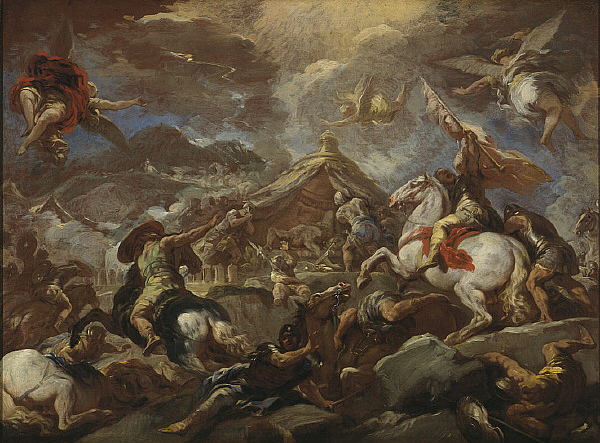
Luca Giordano, The Discovery of the Body of Holofernes, 1703, Saint Louis Art Museum.

I have completed a draft translation of the Commentary by the Blessed Rabanus Maurus on the fourteenth chapter of Judith. The entire translation project, An Explanation of the Book of Judith, is also available for viewing.

This particular chapter is rather short, so the highlights are scant. In the previous chapter, Judith exhibited the head of Holofernes to the inhabitants of Bethulia. Bolstered by this defeat over one of the most powerful men in the world by a “mere” woman, the citizens are primed for a confrontation.

Likewise, the Church, also a woman, has overcome the ancient enemy. Rabanus helps us to flesh out the impact of this defeat on the citizens of heaven.

The Church, with maternal affection as well as magisterial authority, teaches her children how they should pursue the spiritual enemy: clearly that as soon as the sun rises they should hang the head of their enemy upon their walls. That is, as soon as the serenity of divine reconciliation and supernal solace have illuminated them, the believers should, with the Gospel teaching by which they are strengthened, disclose the wounded pride of the ancient enemy to everyone. And clothed with celestial weapons, that is with the shield of faith, the breastplate of justice, the helmet of salvation, and the sword of the spirit which is the Word of God, they should—not sluggishly, but vigorously—pursue the flying wedge of enemies.

The flying wedge is a traditional offensive military formation used by the Romans and still in use today in the military and even in the game of football. Rabanus likes to make the story real.

For some reason I feel a song coming on…

Onward Christian soldiers! 
marching as to war...

(For further information about this translation project, please see my series of posts on Judith.)

Judith: Chapter 13 Commentary

August von Heckel, Judith shows her people the head of the Holofernes, c. 1857, Oil on canvas.

I have completed a draft translation of the Commentary by the Blessed Rabanus Maurus on the thirteenth chapter of Judith. The entire translation project, An Explanation of the Book of Judith, is also available for viewing. I’d like to share some highlights from the chapter.

In chapter thirteen, the deed is done. Holofernes loses his head. (Chapter thirteen does seem apropos for the loss of one’s head). The Blessed Rabanus Maurus finds this event and its setting to be to be a veritable treasure trove of practical object lessons, rich with allegory.

As Holofernes lies completely sloshed in his bed, Rabanus crafts an image in which each object in the tent takes on an allegorical meaning. In verse 5 he says:

The pillar that was at the head of Holofernes’ bed signifies the hardness of the depraved heart that generated the error of faithless complacency. The sword that hung tied upon it is the malice of evil intention; the hair of the head: the exaltation of an arrogant mind; the neck, in truth: the stubbornness of evil action; and the canopy, which is a net for flies, signifies the snares of deceitful thought.

Recall that Judith represents the Holy Church. Rabanus now takes this symbolism and applies it to the way in which the Holy Church works even today in verses 6 and 7:

She goes to the pillar and looses the sword, by which she might cut off the head of the most wicked enemy; with the malice of a hard heart stripped away, she cuts off from the enemy the opportunity for fierce temptation [or attack].

She removes the canopy because she uncovers his deceptions, with which he strives to entangle the guileless and incautious, and in the same way she is “rolling away the headless body of the enemy” whenever she shows the enemy himself to be infirm and debilitated in every part, with the result that the easier the soldiers of Christ think the most wicked enemy himself can be overcome, the more thoroughly they learn that he will be weak and conquerable.

Later on in verse 24, Rabanus connects this remarkable defeat with the prophesy made in the book of Genesis, and also God’s enabling of the apostles (the founders of the Church) with power over the enemy. He says:

…the Lord says to the cunning serpent in the beginning, “She shall crush thy head” (Gn 3:15). And the Truth Himself says to Her in the Gospel, “Behold, I give you power to tread upon serpents and scorpions, and upon all the power of the enemy” (Lk 10:19).

But not only does God, through the Church, overcome the devil. The Church also uncovers what the devil and his minions are up to so that he is easily seen through. In Bethulia, Judith presents the head to her people in triumph. Rabanus likens this demonstration to the Church’s exposition of the devil’s deceptions in verse 27:

Judith is bringing forth the head of Holofernes in the view of the people and showing them “his canopy, wherein he lay in his drunkenness,” whenever the Holy Church exposes in lucid discourse the ancient enemy’s arrogant mind and plainly uncovers for them his deception, in which the majority wickedly believed, so that they might know how perverse their enemy is and the magnitude of the omnipotent God’s righteousness, by which, under the authority of faithful spirits, he was overcome and driven back.

This is a useful image. Judith holding the head of Holofernes is an image worth imagining every time the devil’s schemes are exposed by the Church. And what are we to do with this knowledge? Rabanus gives that answer very clearly in verse 28:

Divine protection preserves these unharmed from every fraud of the enemy and the contamination of error, so that, with all these things having been fully understood, they give proper thanks and they unceasingly give back devoted praises to their creator and redeemer in return for this.

For further information about this translation project, please see my series of posts on Judith.

Judith: Chapter 12 Commentary

Judith () Veronese 3
Paolo Veronese (circle of), Judith feasted by Holofernes, Oil on canvas,” The Ashmolean Museum of Art and Archaeology Oxford, England, UK

I have completed a draft translation of the Commentary by the Blessed Rabanus Maurus on the twelfth chapter of Judith. The entire translation project, An Explanation of the Book of Judith, is also available for viewing.

In this chapter Holofernes stashes Judith in his treasure chamber with the rest of his treasure. This seems quite symbolic. The good Abbot, Rabanus, comments on it in verse 3, noting that it symbolizes the secular leadership holding preachers of the Gospel in high regard:

What does it mean that Holofernes instructed Judith to stay in the place “where his treasures were laid up,” unless it means that the leadership of this age consents to hold a very great position for the preachers of the Gospel among those who have a mind that is both intelligent and a recipient of sound faith? For the intensification of a virtuous will is the most valuable treasure of the heart, where the figurative Judith stays, because the Holy Church steadfastly resides there.

The rest of the story is focused on Holofernes’ attempt to draw Judith into his revelry and to seduce her. He is absolutely smitten by her and can’t stand the thought of having her in his camp without having her in his bed. He tries to talk her into eating his food and drinking his wine, but she insists on eating the food that she has brought with her and that is prepared by her maid, so that she won’t be defiled by his food.

Holofernes is a bit put off by this and looks for a way to draw Judith into his feasting. He sees that she has meager provisions and hopes that by this he can draw her into consumption of his victuals. Her food symbolizing her religion, Rabanus observes that this event represents the fact that among secular leaders ,”the worship of the Christian religion is seen to be of little value and they strive to draw its practitioners into the filth of images or the seductions of the carnal pleasures” (verse 4).

Then, alluding to a means of escape from these traps, he describes a practice that aligns closely with the practice of some Orthodox countries or Jurisdictions even today. In preparation for receiving the Eucharist, many Orthodox faithful fast and pray during three days of confession leading up to Holy Communion. Recall that Rabanus Maurus was an Abbot in what is present day Germany. Consequently, it seems plausible that the practice we find in many Orthodox countries today was also found in eighth century western Europe. The blessed abbot describes it this way (verse 5):

But those with a faithful soul and a sure hope assure themselves that divine grace quickly comes to help, persist in prayers the entire night of this world, and baptize themselves with a fountain of tears; they wash the bed of their heart with a psalm throughout each night and water the couch of their thoughts with pious tears (cf. Ps 6:7); and in this manner during the three days of Catholic confession, completing their prayer through faith, hope, and love, (cf. 1 Cor 13:13) they finally on the fourth day, that is in the scintillating light of the Gospel, prepare for themselves victory over the enemy, and the author of death and darkness himself, blinded by his own malice, they convict as guilty, with eternal liability.

The key for Rabanus is that the Holy Church and her members remain pure in spite of living in the secular world. Consuming her own food, she is “in no way polluted by the idolatry or superstition of the Gentiles,” but has, as the Lord Himself said to his Disciples, “meat to eat, which you know not … My meat is to do the will of Him that sent me, that I may perfect His work.”

UPDATE (8/7/2019): After more research, it seems that the above description of a penitential practice may instead be alluding to the quarterly penance practiced by all Christians during a period now known as Ember Days or Embertide. The three Ember Days were always on Wednesday, Friday, and Saturday of the same week. On the fourth day, Sunday, the faithful would celebrate Holy Mass. These days were widely observed throughout the Frankish empire by the time of Rabanus Maurus, having been enjoined by Charlemagne in 769. Embertide does not seem to have ever been observed in the eastern Church.

For further information about this translation project, please see my series of posts on Judith.

Judith: Chapter 11 Commentary

Paolo Veronese (circle of), Judith Falling to Her Knees, Oil on canvas, The Ashmolean Museum of Art and Archaeology, Oxford, England, UK

I’m pleased to make available a draft of my translation of the commentary by the Blessed Rabanus Maurus on the eleventh chapter of Judith. The entire translation project is also available for viewing: An Explanation of the Book of Judith.

At the end of chapter ten, Judith arrives in the camp of Holofernes and bows before him, showing respect. In chapter eleven, she very cleverly employs a goodly bit of truth to beguile Holofernes into believing that she has defected to his side and wants to help him conquer the Jews. Holofernes, being charmed by Judith’s divinely enhanced beauty, falls for her.

Judith’s speech is an interesting one. The Blessed Rabanus Maurus, our expositor, finds in her words a prophecy of distant future events described by Josephus through the proxies of Eusebius of Caesarea and Tyrannius Rufinus. Rabanus quotes extensively from Rufinus’ history to demonstrate the fulfillment of Judith’s prophecy. Rufinus is a historian who extended, revised, and translated Eusebius’ history (into Latin). And Eusebius himself quoted extensively from Josephus’ account of Titus’ siege of Jerusalem in AD 70.

Eusebius’ commentary on the events highlights the intent behind Rabanus’ citation (verse 4):

However, the Church that had been assembled in Jerusalem was commanded in a response received from God to leave and go over to a certain town across the Jordan, Pella by name; so that with the holy and just men withdrawn from the city, it might become a place of retribution for heaven, as much upon the sacrilegious city as upon the impious people, through the destruction of the fatherland and for the imposing of expulsion.

This aligns with what Judith told Holofernes (verse 1):

For it is certain that our God is so offended with sins, that he hath sent word by his prophets to the people, that he will deliver them up for their sins. And because the children of Israel know they have offended their God, thy dread is upon them.

But how does Holofernes respond to Judith’s description of the future? Judith is a knockout, and Holofernes seems to be lured into her trap by her beauty, buying most of what she says. But, Rabanus juxtaposes Holofernes with Herod, revealing a parallel between Holofernes’ apparent interest in the God of the Jews and Herod’s exploitation of the wise men. Maybe Holofernes is more shrewd than we thought. Wrapping up the chapter, Rabanus makes this practical (verse 16).

…blessed is he who receives an ambassador of the truth, not with a depraved spirit, but with pure disposition of heart; because whoever pretends to seek out God Himself with perverse intent, together with Holofernes and Herod (cf. Mt 2:8), will never, joyful at the sight of His glory, rejoice to reach Him, but in the end he will be sorry that he suffers the well deserved punishments of his iniquity.

For further information about this translation project, please see my series of posts on Judith.